Quasinormal operator
In operator theory, quasinormal operators is a class of bounded operators defined by weakening the requirements of a normal operator.
Every quasinormal operator is a subnormal operator. Every quasinormal operator on a finite-dimensional Hilbert space is normal.
Definition and some properties
Definition
Let A be a bounded operator on a Hilbert space H, then A is said to be quasinormal if A commutes with A*A, i.e.

Properties
A normal operator is necessarily quasinormal.
Let A = UP be the polar decomposition of A. If A is quasinormal, then UP = PU. To see this, notice that the positive factor P in the polar decomposition is of the form (A*A)1⁄2, the unique positive square root of A*A. Quasinormality means A commutes with A*A. As a consequence of the continuous functional calculus for self-adjoint operators, A commutes with P = (A*A)1⁄2 also, i.e.

So UP = PU on the range of P. On the other hand, if h ∈ H lies in kernel of P, clearly UP h = 0. But PU h = 0 as well. because U is a partial isometry whose initial space is closure of range P. Finally, the self-adjointness of P implies that H is the direct sum of its range and kernel. Thus the argument given proves UP = PU on all of H.
On the other hand, one can readily verify that if UP = PU, then A must be quasinormal. Thus the operator A is quasinormal if and only if UP = PU.
When H is finite dimensional, every quasinormal operator A is normal. This is because that in the finite dimensional case, the partial isometry U in the polar decomposition A = UP can be taken to be unitary. This then gives

In general, a partial isometry may not be extendable to a unitary operator and therefore a quasinormal operator need not be normal. For example, consider the unilateral shift T. T is quasinormal because T*T is the identity operator. But T is clearly not normal.
Quasinormal invariant subspaces
It is not known that, in general, whether a bounded operator A on a Hilbert space H has a nontrivial invariant subspace. However, when A is normal, an affirmative answer is given by the spectral theorem. Every normal operator A is obtained by integrating the identity function with respect to a spectral measure E = {EB} on the spectrum of A, σ(A):
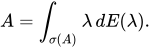
For any Borel set B ⊂ σ(A), the projection EB commutes with A and therefore the range of EB is an invariant subspace of A.
The above can be extended directly to quasinormal operators. To say A commutes with A*A is to say that A commutes with (A*A)1⁄2. But this implies that A commutes with any projection EB in the spectral measure of (A*A)1⁄2, which proves the invariant subspace claim. In fact, one can conclude something stronger. The range of EB is actually a reducing subspace of A, i.e. its orthogonal complement is also invariant under A.
References
- P. Halmos, A Hilbert Space Problem Book, Springer, New York 1982.
Content Disclaimer
Informasi ini disarikan dari Wikipedia dan disajikan kembali untuk tujuan edukasi. Konten tersedia di bawah lisensi CC BY-SA 3.0. Kami tidak bertanggung jawab atas ketidakakuratan data yang bersumber dari kontribusi publik tersebut.
- The information displayed on this website is sourced in part or in whole from Wikipedia and has been adapted for the purpose of restating it. We strive to provide accurate and relevant information, however:
- There is no guarantee of absolute accuracy. Wikipedia is an open, collaborative project that can be edited by anyone, so information is subject to change.
- It is not intended to constitute professional advice. The content displayed is for informational and educational purposes only. For important decisions (e.g., medical, legal, or financial), please consult a professional.
- Content copyright. Wikipedia is licensed under the Creative Commons Attribution-ShareAlike License (CC BY-SA). This means that content may be reused with appropriate attribution and shared under a similar license.
- Responsible use. Any risk arising from the use of information from this website is entirely the responsibility of the user.