Process gain
 | This article needs additional citations for verification. (February 2024) |

In a spread-spectrum system, the process gain (or "processing gain") is the ratio of the spread (or RF) bandwidth to the unspread (or baseband) bandwidth. Research suggests that it is one of the important factors in making decisions over the performance of system in jamming environment.[1]
It is usually expressed in decibels (dB). For example, if a 1 kHz signal is spread to 100 kHz, the process gain expressed as a numerical ratio would be 100000/1000 = 100. Or in decibels, 10 log10(100) = 20 dB.
Note that process gain does not reduce the effects of wideband thermal noise. It can be shown that a direct-sequence spread-spectrum (DSSS) system has exactly the same bit error behavior as a non-spread-spectrum system with the same modulation format. Thus, on an additive white Gaussian noise (AWGN) channel without interference, a spread system requires the same transmitter power as an unspread system, all other things being equal.
Unlike a conventional communication system, however, a DSSS system does have a certain resistance against narrowband interference, as the interference is not subject to the process gain of the DSSS signal, and hence the signal-to-interference ratio is improved.
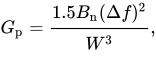
In frequency modulation (FM), the processing gain can be expressed as
where:
- Gp is the processing gain,
- Bn is the noise bandwidth,
- Δf is the peak frequency deviation,
- W is the sinusoidal modulating frequency.
References
- ^ Deshmukh, Sanjay; Bhosle, Udhav (2016). "Performance Evaluation of Spread Spectrum System Using Different Modulation Schemes". Procedia Computer Science. 85: 178. doi:10.1016/j.procs.2016.05.207.
 | This article related to telecommunications is a stub. You can help Wikipedia by adding missing information. |
Content Disclaimer
Informasi ini disarikan dari Wikipedia dan disajikan kembali untuk tujuan edukasi. Konten tersedia di bawah lisensi CC BY-SA 3.0. Kami tidak bertanggung jawab atas ketidakakuratan data yang bersumber dari kontribusi publik tersebut.
- The information displayed on this website is sourced in part or in whole from Wikipedia and has been adapted for the purpose of restating it. We strive to provide accurate and relevant information, however:
- There is no guarantee of absolute accuracy. Wikipedia is an open, collaborative project that can be edited by anyone, so information is subject to change.
- It is not intended to constitute professional advice. The content displayed is for informational and educational purposes only. For important decisions (e.g., medical, legal, or financial), please consult a professional.
- Content copyright. Wikipedia is licensed under the Creative Commons Attribution-ShareAlike License (CC BY-SA). This means that content may be reused with appropriate attribution and shared under a similar license.
- Responsible use. Any risk arising from the use of information from this website is entirely the responsibility of the user.