Portal:Insects

The Insects Portal


Insects (from Latin insectum) are hexapod invertebrates of the class Insecta. They are the largest group within the arthropod phylum. Insects have a chitinous exoskeleton, a three-part body (head, thorax and abdomen), three pairs of jointed legs, compound eyes, and a pair of antennae. Insects are the most diverse group of animals, with more than a million described species; they represent more than half of all animal species. (Full article...)
Selected article -

Zigrasimecia, also known as iron-maiden ants, is an extinct genus of ants which existed in the Cretaceous period approximately 98 million years ago. The first specimens were collected from Burmese amber in Kachin State, 100 kilometres (62 mi) west of Myitkyina town in Myanmar. In 2013, palaeoentomologists Phillip Barden and David Grimaldi published a paper describing and naming Zigrasimecia tonsora. They described a dealate female with unusual features, notably the highly specialized mandibles. Other features include large ocelli, short scapes, 12 antennomeres, small eyes, and a clypeal margin that has a row of peg-like denticles. The genus Zigrasimecia was originally incertae sedis (uncertain placement) within Formicidae until a second species, Zigrasimecia ferox, was described in 2014, leading to its placement in the subfamily Sphecomyrminae. Later, it was considered to belong to the distinct subfamily Zigrasimeciinae. Zigrasimecia has 12 described species.
Due to the highly specialized mandibles, scientists believe that the ants exhibited habits no longer seen in extant ants. The highly movable head suggests that mobility was an important factor for them (probably for feeding behavior), and the rugose projections may have played a major role in nest excavation because the mandibles would have prevented such activity. Zigrasimecia most likely interacted with the extinct ant genus Gerontoformica through conflict and probably shared some of their ecological niches. The mandibles of these ants were probably used for mechanical interactions with food, and they may also have served as traps for potential arthropod prey such as mites and small flies. Zigrasimecia was possibly a generalist predator. (Full article...)
Did you know -
- ... that the nearest living relatives of Eosacantha, a fossil tortoise beetle from Colorado, are found in Africa, tropical Asia, and Australia?
- ... that the extinct sweat bee Halictus? savenyei was the first fossil bee from Canada to be described?
- ... that the extinct planthopper Emiliana was described from a single 47 million year old wing?
- ... that the Albian 100-million-year-old fossil wasp Myanmymar is only half a millimetre long?
- ... that fairyflies include the smallest known insects, smaller than a single-celled Paramecium?
List articles

Related portals


General images -
-
 Mandibles of Rhyniognatha hirsti, it may be one of the oldest insects, but also possible to be a myriapod. (from Evolution of insects)
 -
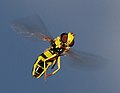 Hoverfly (Philhelius pedissequum) has indirect flight musculature. (from Insect flight)
 -
 Insect morphology
Legend of body parts
Tagmata: A – Head, B – Thorax, C – Abdomen.(from Insect morphology)- antenna
- ocelli (lower)
- ocelli (upper)
- compound eye
- brain (cerebral ganglia)
- prothorax
- dorsal blood vessel
- tracheal tubes (trunk with spiracle)
- mesothorax
- metathorax
- forewing
- hindwing
- mid-gut (stomach)
- dorsal tube (heart)
- ovary
- hind-gut (intestine, rectum & anus)
- anus
- oviduct
- nerve cord (abdominal ganglia)
- Malpighian tubes
- tarsal pads
- claws
- tarsus
- tibia
- femur
- trochanter
- fore-gut (crop, gizzard)
- thoracic ganglion
- coxa
- salivary gland
- subesophageal ganglion
- mouthparts
-
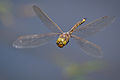 The Odonata (dragonflies and damselflies) have direct flight musculature. (from Insect flight)
 -
 Diagram of a typical insect leg (from Insect morphology)
 -
 Evolution has produced astonishing variety of appendages in insects, such as these antennae. (from Evolution of insects)
 -
 Stylized diagram of insect digestive tract showing malpighian tubule, from an insect of the order Orthoptera. (from Insect morphology)
 -
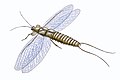
-
 Direct flight: muscles attached to wings. Large insects only (from Insect flight)
 -
 A tau emerald (Hemicordulia tau) dragonfly has flight muscles attached directly to its wings. (from Insect flight)
 -
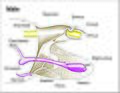 Male genitalia of Lepidoptera (from Insect reproductive system)
 -
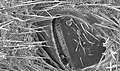 Scanning electron micrograph of a cricket spiracle valve (from Respiratory system of insects)
 -
 Variety of male structures in Phlebotominae (Diptera, Psychodidae) (from Insect reproductive system)
 -
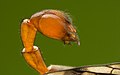 The abdominal terminus of male scorpionflies is enlarged into a "genital bulb", as seen in Panorpa communis (from Insect morphology)
 -
 Generalized arthropod biramous limb. Trueman proposed that an endite and an exite fused to form a wing. (from Insect flight)
 -
Mazothairos, a Carboniferous member of the now extinct order Palaeodictyoptera. (from Evolution of insects)
-
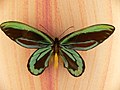 Queen Alexandra's birdwing (Ornithoptera alexandrae) of Papua New Guinea (from Insect biodiversity)
 -
 Indian moon moth (Actias selene) with some of the spiracles identified (from Respiratory system of insects)
 -
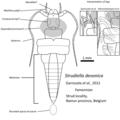 Reconstruction of Strudiella devonica as a possible hexapod (from Evolution of insects)
 -
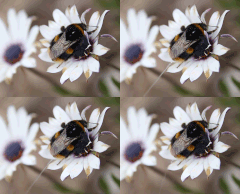 Bumblebee defecating. Note the contraction of the anus, which provides internal pressure. (from Insect morphology)
 -
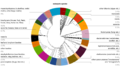 A pie chart of described eukaryote species, showing just over half of these to be insects (from Insect biodiversity)
 -

-
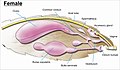 The female genitalia of Lepidoptera (from Insect reproductive system)
 -
 Frenulo-retinacular wing coupling in male and female moths (from Insect flight)
 -
 Cross-section of wing vein (from Insect morphology)
 -
 Mayfly nymph with paired abdominal gills (from Insect flight)

.jpg)


.png)


.jpg)


.JPG)
Selected image -


The rose chafer Cetonia aurata (Coleoptera: Scarabaeidae) is a beetle, 20 mm (¾ in) long, that has metallic green coloration.
Topics
| |||||||||||||||
| |||||||||||||||
| |||||||||||||||

| Aspects of insects in culture |
| ||||||||||||||
|---|---|---|---|---|---|---|---|---|---|---|---|---|---|---|---|
| Pioneers |
| ||||||||||||||
| Concerns | |||||||||||||||
| Categories, templates | |||||||||||||||

Subcategories

WikiProjects

Main WikiProject:
Related projects:
- WikiProject Arthropods
- WikiProject Spiders
- WikiProject Animals
- WikiProject Tree of Life
- WikiProject Biology
Daughter projects:
Tasks
 |
Here are some tasks awaiting attention:
|
Associated Wikimedia
The following Wikimedia Foundation sister projects provide more on this subject:
-
 Commons
Free media repository -
 Wikidata
Free knowledge base -
 Wikiquote
Collection of quotations -
 Wikisource
Free-content library -
 Wikiversity
Free learning tools -
 Wiktionary
Dictionary and thesaurus


Content Disclaimer
Informasi ini disarikan dari Wikipedia dan disajikan kembali untuk tujuan edukasi. Konten tersedia di bawah lisensi CC BY-SA 3.0. Kami tidak bertanggung jawab atas ketidakakuratan data yang bersumber dari kontribusi publik tersebut.
- The information displayed on this website is sourced in part or in whole from Wikipedia and has been adapted for the purpose of restating it. We strive to provide accurate and relevant information, however:
- There is no guarantee of absolute accuracy. Wikipedia is an open, collaborative project that can be edited by anyone, so information is subject to change.
- It is not intended to constitute professional advice. The content displayed is for informational and educational purposes only. For important decisions (e.g., medical, legal, or financial), please consult a professional.
- Content copyright. Wikipedia is licensed under the Creative Commons Attribution-ShareAlike License (CC BY-SA). This means that content may be reused with appropriate attribution and shared under a similar license.
- Responsible use. Any risk arising from the use of information from this website is entirely the responsibility of the user.