Point-normal triangle

The curved point-normal triangle, in short PN triangle, is an interpolation algorithm to retrieve a cubic Bézier triangle from the vertex coordinates of a triangle (under the usual polygon definition of a triangle) and normal vectors. The PN triangle retains the vertices of the original triangle as well as the corresponding normals. For computer graphics applications, additionally a linear or quadratic interpolant of the normals is created to represent an incorrect but plausible normal when rendering and so giving the impression of smooth transitions between adjacent PN triangles.[1] The usage of the PN triangle enables the visualization of triangle based surfaces in a smoother shape at low cost in terms of rendering complexity and time.
Mathematical formulation
With information of the given vertex positions of a triangle and the according normal vectors at the vertices a cubic Bézier triangle is constructed. Following the notation and nomenclature of G. Farin (2002),[2] one denotes the 10 control points as with the positive indices holding the condition .




The first three control points are equal to the given vertices. Six control points related to the triangle edges, i.e. are computed asThis definition ensures that the original vertex normals are reproduced in the interpolated triangle.



Finally the internal control point is derived from the previously calculated control points as

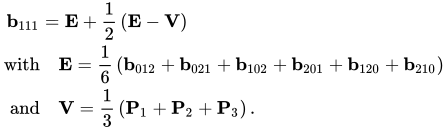
An alternative interior control point was suggested in Kato (2002).[3]

References
- ^ Vlachos, Alex; Peters, Jörg; Boyd, Chas; Mitchell, Jason L. (2001-03-01). Curved PN triangles. ACM. pp. 159–166. doi:10.1145/364338.364387. ISBN 978-1581132922. S2CID 5227025.
- ^ Farin, Gerald E. (2002). Curves and surfaces for CAGD : a practical guide (5th ed.). San Francisco, CA: Morgan Kaufmann. ISBN 9780080503547. OCLC 181100270.
- ^ USA 6,462,738, Kato, Saul S., "Curved Surface Reconstruction", published oct. 08, 2002
Content Disclaimer
Informasi ini disarikan dari Wikipedia dan disajikan kembali untuk tujuan edukasi. Konten tersedia di bawah lisensi CC BY-SA 3.0. Kami tidak bertanggung jawab atas ketidakakuratan data yang bersumber dari kontribusi publik tersebut.
- The information displayed on this website is sourced in part or in whole from Wikipedia and has been adapted for the purpose of restating it. We strive to provide accurate and relevant information, however:
- There is no guarantee of absolute accuracy. Wikipedia is an open, collaborative project that can be edited by anyone, so information is subject to change.
- It is not intended to constitute professional advice. The content displayed is for informational and educational purposes only. For important decisions (e.g., medical, legal, or financial), please consult a professional.
- Content copyright. Wikipedia is licensed under the Creative Commons Attribution-ShareAlike License (CC BY-SA). This means that content may be reused with appropriate attribution and shared under a similar license.
- Responsible use. Any risk arising from the use of information from this website is entirely the responsibility of the user.