Place du Châtelet
Place du Châtelet | |
|---|---|
| Public Square | |
 Fontaine du Palmier in the Place du Châtelet, 2022 | |
| Features | Fontaine du Palmier, Théâtre du Châtelet, Théâtre de la Ville |
| Construction | 1802-1810 |
| Opening date | 1810 |
| Location | Paris |
  Place du Châtelet | |
| Coordinates: 48°51′27.5″N 2°20′50.5″E / 48.857639°N 2.347361°E | |
_01.jpg)
The Place du Châtelet (French pronunciation: [plas dy ʃɑtlɛ]) is a public square in Paris, on the right bank of the river Seine, on the borderline between the 1st and 4th arrondissements. It lies at the north end of the Pont au Change, a bridge that connects the Île de la Cité, near the Palais de Justice and the Conciergerie, to the right bank. The closest métro station is Châtelet 


Features

The name "Châtelet" refers to the stronghold, the Grand Châtelet, that guarded the northern end of the Pont au Change, containing the offices of the prévôt de Paris and a number of prisons, until it was demolished from 1802 to 1810.[1]
At the square's center is the Fontaine du Palmier, designed in 1806 by architect and engineer François-Jean Bralle (1750-1832) to celebrate French victories in battle. It has a circular basin, 6 m (20 ft) in diameter, from which a column rises in the form of a palm tree's trunk 18 m (59 ft) tall. The palm trunk is surmounted by a gilded figure of the goddess, Victory, holding a laurel wreath in each upraised hand; the goddess figure stands on a base ornamented with bas-relief eagles. The gilded finial is by sculptor Louis-Simon Boizot.
Four allegorical figures also by Boizot ring the base of the fountain: Prudence, Temperance, Justice, and Strength. From top to bottom, bands of bronze gilt pay tribute to the victories achieved in the following battles: the Siege of Danzig (1807), the Battle of Ulm (1805), the Battle of Marengo (1800), the Battle of the Pyramids (1798), and the Battle of Lodi (1796). Its sphinxes were designed in 1858 by Gabriel Davioud and sculpted by Henri Alfred Jacquemart (1824-1896); they commemorate Napoleon's victory in Egypt.
Two identical-looking theatres stand facing the square, the Théâtre du Châtelet and the Théâtre de la Ville, both designed by architect Gabriel Davioud and completed between 1860 and 1862 as part of Baron Haussmann's grand reconfiguration of Paris.
Gallery
-
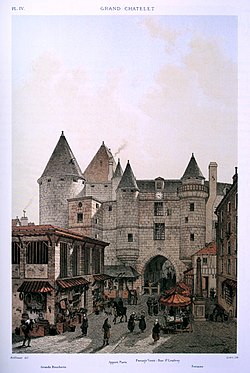 The Grand Châtelet from rue Saint-Denis (1800)
 -
 The Victory Column with the Saint-Jacques Tower
 -
 Théâtre de la Ville
 -
 Interior of the Théâtre du Châtelet


References
- ^ Jacques Hillairet, Dictionnaire historique des rues de Paris, 8th ed. (Éditions de Minuit, 1985), Vol. 1, pp. 331-34.
Sources
- The History of Paris from the Earliest Period to the Present Day, London : printed for Geo. B. Whittaker, Ave-Maria Lane, 1825, vol. 3, page 122.
See also

Content Disclaimer
Informasi ini disarikan dari Wikipedia dan disajikan kembali untuk tujuan edukasi. Konten tersedia di bawah lisensi CC BY-SA 3.0. Kami tidak bertanggung jawab atas ketidakakuratan data yang bersumber dari kontribusi publik tersebut.
- The information displayed on this website is sourced in part or in whole from Wikipedia and has been adapted for the purpose of restating it. We strive to provide accurate and relevant information, however:
- There is no guarantee of absolute accuracy. Wikipedia is an open, collaborative project that can be edited by anyone, so information is subject to change.
- It is not intended to constitute professional advice. The content displayed is for informational and educational purposes only. For important decisions (e.g., medical, legal, or financial), please consult a professional.
- Content copyright. Wikipedia is licensed under the Creative Commons Attribution-ShareAlike License (CC BY-SA). This means that content may be reused with appropriate attribution and shared under a similar license.
- Responsible use. Any risk arising from the use of information from this website is entirely the responsibility of the user.