Pinball Factory
| Pinball Factory | |
|---|---|
 Atari ST version box art | |
| Publishers | Microdeal (Atari ST), MichTron Inc. (TRS-80) |
| Programmer | Kary McFadden |
| Artist | Harry Lafnear ("Wild Fire")
Douglas W. Frayer (v1.1 tables) |
| Platforms | Atari ST, TRS-80 CoCo |
| Release | 1986 |
| Genre | Pinball |
| Modes | single-player, multiplayer |
Pinball Factory is a 1986 pinball video game released for the Atari ST and TRS-80 computers. Users created their own pinball game layouts before saving or playing them.
Gameplay

After loading the game, a table called "Wild Fire" is shown. The game can be edited using a palette of 16 colours and a set of predefined targets, bumpers, rubbers, and other items. A single pair of flippers is in a fixed position, and no further flippers can be added. Tables can be designed with two- or three-ball multiballs.[1] The 16 colours used can be selected from 512 variations; ten brushes can be used.[2] A logo for the table could also be edited.[3]
Physical characteristics can be altered, including gravity, elasticity, speed, bumper strength, and extra ball rules.[2]
The game can be controlled with a keyboard, or the mouse can be used to control the flippers. Up to four players can play, and its possible to nudge the table[2] in three directions.[4] A thirteen page manual is included.[3]
After the initial release, a 1.1 version released adding three further tables.
The pinball data files of the TRS-80 version are stored in a special format. Up to 90 objects could be placed on the playfield.[4]
Reception
| Publication | Score |
|---|---|
| Atari ST User | AST: 8/10[2] |
| Aktueller Software Markt | AST: 32/40[5] |
| Tilt | AST: 19/24[6] |
| The Rainbow | TRS-80: 4/5[4] |
Reviewing the Atari ST version, Pinball Player found that attempting to save the game when the disk is full didn't save the game and gave no error message. It was found to have a good set of drawing tools and was characterized as a drawing program with pinball attached. The program gave no indication of what added to the score, and summed it up as "A frustrating package and one to be avoided at all cost!"[1] Atari ST User rated the game generally more favourably, although rated the sound at 3/10.[2] Antic compared the game to Pinball Construction Set, noting that Pinball Factory had better graphics, but lacked several features present in Pinball Construction Set including the ability to move and add flippers.[3] CVG praised the customization options, recommending it for pinball fans.[7]
The Rainbow reviewed the TRS-80 CoCo version noting the animation was good and mostly flicker-free, with the sound effects adequate but not diverse. The creation of custom pinball games was found to be excellent, although ramps and additional flippers were not options.[4]
References
- ^ a b Smout, John (January–February 1989). "Pinball Goes Soft". Pinball Player. Vol. 13, no. 1. pp. 6–7.
- ^ a b c d e Wooller, Douglas (March 1987). "Doing your own pin thing". Atari ST User. Vol. 2, no. 1. p. 18.
- ^ a b c Plotkin, David (April 1987). "ST Reviews". Antic. Vol. 5, no. 12. pp. 61–62, 67. ISSN 0745-2527.
- ^ a b c d Tilenius, Eric (August 1986). "Pinball Factory Rings Up Points". The Rainbow Magazine. Vol. VI, no. 1. p. 134. ISSN 0746-4797.
- ^ "Die Flipperfabrik". ASM (in German). January 1987. p. 36.
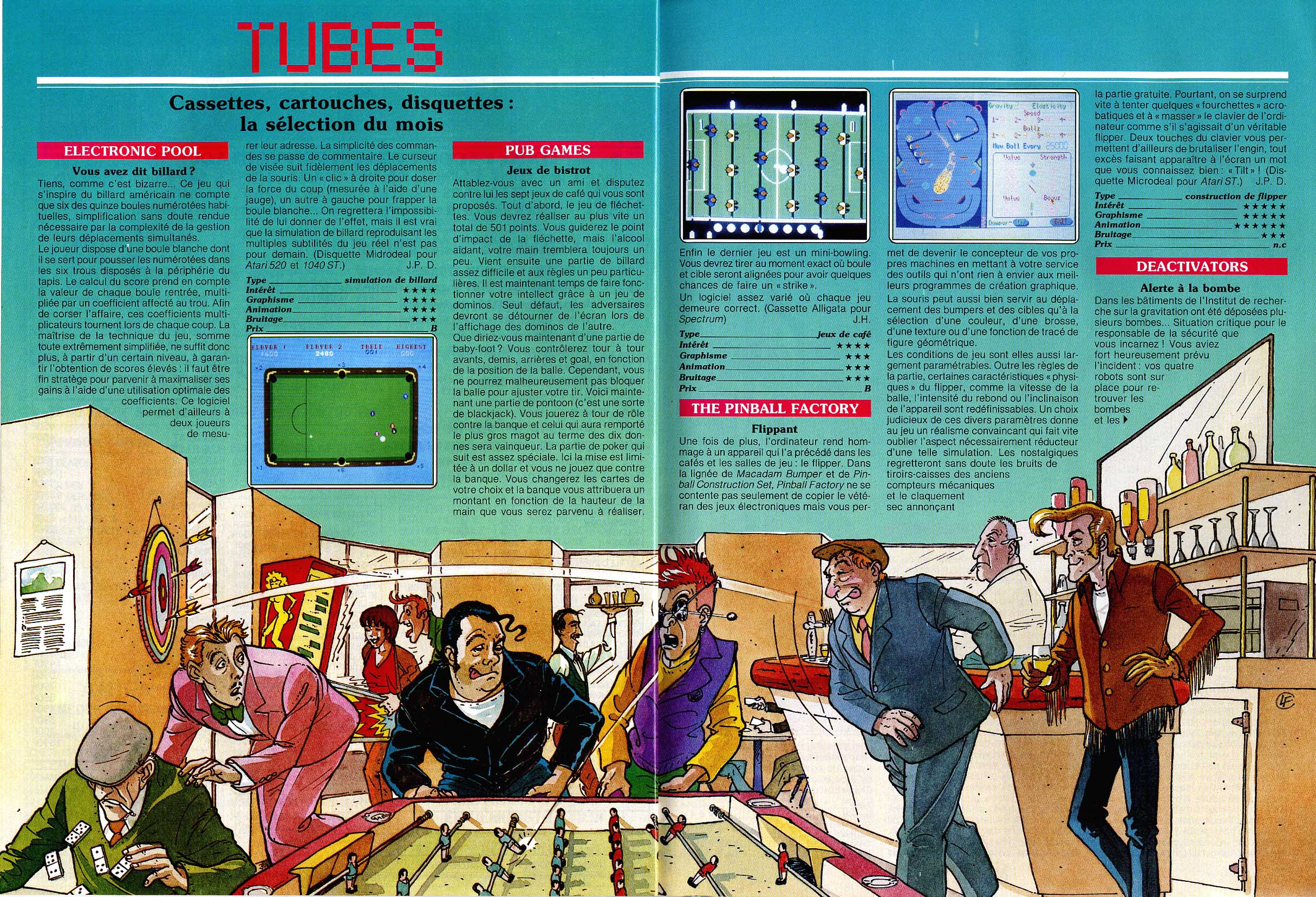
- ^ "Tubes". Tilt (in French). No. 38. January 1987. p. 37.
- ^ "ST Spectacular". Computer & Video Games. No. 64. February 1987. p. 113.
External links
Content Disclaimer
Informasi ini disarikan dari Wikipedia dan disajikan kembali untuk tujuan edukasi. Konten tersedia di bawah lisensi CC BY-SA 3.0. Kami tidak bertanggung jawab atas ketidakakuratan data yang bersumber dari kontribusi publik tersebut.
- The information displayed on this website is sourced in part or in whole from Wikipedia and has been adapted for the purpose of restating it. We strive to provide accurate and relevant information, however:
- There is no guarantee of absolute accuracy. Wikipedia is an open, collaborative project that can be edited by anyone, so information is subject to change.
- It is not intended to constitute professional advice. The content displayed is for informational and educational purposes only. For important decisions (e.g., medical, legal, or financial), please consult a professional.
- Content copyright. Wikipedia is licensed under the Creative Commons Attribution-ShareAlike License (CC BY-SA). This means that content may be reused with appropriate attribution and shared under a similar license.
- Responsible use. Any risk arising from the use of information from this website is entirely the responsibility of the user.