Payload Assist Module
The Payload Assist Module (PAM) is a modular upper stage designed and built by McDonnell Douglas (Boeing), using Thiokol Star-series solid propellant rocket motors. The PAM was used with the Space Shuttle, Delta, and Titan launchers and carried satellites from low Earth orbit to a geostationary transfer orbit or an interplanetary course. The payload was spin stabilized by being mounted on a rotating plate.[1] Originally developed for the Space Shuttle, different versions of the PAM were developed:
- PAM-A (Atlas class), development terminated; originally to be used on both the Atlas and Space Shuttle, designed for satellites up to 4,400 lb (2,000 kg)
- PAM-D (Delta class), uses a Star-48B rocket motor, designed for satellites up to 2,750 lb (1,250 kg)[2]
- PAM-DII (Delta class), uses a Star-63 rocket motor, designed for satellites up to 4,150 lb (1,880 kg)[2]
- PAM-S (Special), uses a Star-48B as a kick motor for the space probe Ulysses[2]
The PAM-D module was used as an optional third stage of the classic Delta rocket. The PAM-D was discontinued after the Challenger accident. A simplified 3rd stage using the STAR-48 motor was employed on Delta II.
2001 re-entry incident
On January 12, 2001, a PAM-D module re-entered the atmosphere after a "catastrophic orbital decay".[3] The PAM-D stage, which had been used to launch the GPS satellite 2A-11 in 1993, crashed in the sparsely populated Saudi Arabian desert, where it was positively identified.[3]
Gallery
-
 PAM-D stage in assembly
 -
 SBS-3 satellite with PAM-D stage being launched from Space Shuttle Columbia
 -
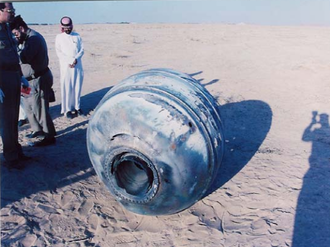 Saudi officials inspect a PAM-D module that re-entered the atmosphere in 2001
 -
 SATCOM KU-2 attached to a PAM-DII is being released from the cargo bay of the Space Shuttle Orbiter Atlantis during STS-61B
 -
 Ulysses is mated with the PAM-S


References
- ^ "Payload Assist Module (PAM)". Global Security. Retrieved June 8, 2012.
- ^ a b c Krebs, Gunter D. "PAM-D, PAM-D2, PAM-S". Gunter's Space Page. Retrieved 2024-01-05.
- ^ a b "PAM-D Debris Falls in Saudi Arabia" (PDF). The Orbital Debris Quarterly News. 6 (2). NASA Johnson Space Center: 1. April 2001.
External links

- Payload Assist Module Archived 2016-12-21 at the Wayback Machine at the NASA Shuttle Reference Manual
- Payload Assist Module at GlobalSecurity.org
Content Disclaimer
Informasi ini disarikan dari Wikipedia dan disajikan kembali untuk tujuan edukasi. Konten tersedia di bawah lisensi CC BY-SA 3.0. Kami tidak bertanggung jawab atas ketidakakuratan data yang bersumber dari kontribusi publik tersebut.
- The information displayed on this website is sourced in part or in whole from Wikipedia and has been adapted for the purpose of restating it. We strive to provide accurate and relevant information, however:
- There is no guarantee of absolute accuracy. Wikipedia is an open, collaborative project that can be edited by anyone, so information is subject to change.
- It is not intended to constitute professional advice. The content displayed is for informational and educational purposes only. For important decisions (e.g., medical, legal, or financial), please consult a professional.
- Content copyright. Wikipedia is licensed under the Creative Commons Attribution-ShareAlike License (CC BY-SA). This means that content may be reused with appropriate attribution and shared under a similar license.
- Responsible use. Any risk arising from the use of information from this website is entirely the responsibility of the user.