Path graph
| Path graph | |
|---|---|
 A path graph on 6 vertices | |
| Vertices | n |
| Edges | n − 1 |
| Radius | ⌊n/2⌋ |
| Diameter | n − 1 |
| Automorphisms | 2 |
| Chromatic number | 2 |
| Chromatic index | 2 |
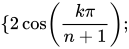
| Spectrum | |
| Properties | Unit distance Bipartite graph Tree |
| Notation | Pn[1] |
| Table of graphs and parameters | |

In the mathematical field of graph theory, a path graph (or linear graph) is a graph whose vertices can be listed in the order v1, v2, ..., vn such that the edges are {vi, vi+1} where i = 1, 2, ..., n − 1. Equivalently, a path with at least two vertices is connected and has two terminal vertices (vertices of degree 1), while all others (if any) have degree 2.
Paths are often important in their role as subgraphs of other graphs, in which case they are called paths in that graph. A path is a particularly simple example of a tree, and in fact the paths are exactly the trees in which no vertex has degree 3 or more. A disjoint union of paths is called a linear forest.
Paths are fundamental concepts of graph theory, described in the introductory sections of most graph theory texts. See, for example, Bondy and Murty (1976), Gibbons (1985), or Diestel (2005).
As Dynkin diagrams
In algebra, path graphs appear as the Dynkin diagrams of type A. As such, they classify the root system of type A and the Weyl group of type A, which is the symmetric group.
See also
- Path (graph theory)
- Ladder graph
- Caterpillar tree
- Complete graph
- Null graph
- Path decomposition
- Cycle (graph theory)
References
- ^ While it is most common to use Pn for a path of n vertices, some authors (e.g. Diestel) use Pn for a path of n edges and n+1 vertices.
- Bondy, J. A.; Murty, U. S. R. (1976). Graph Theory with Applications. North Holland. pp. 12–21. ISBN 0-444-19451-7.
- Diestel, Reinhard (2005). Graph Theory (3rd ed.). Graduate Texts in Mathematics, vol. 173, Springer-Verlag. pp. 6–9. ISBN 3-540-26182-6.
External links
Content Disclaimer
Informasi ini disarikan dari Wikipedia dan disajikan kembali untuk tujuan edukasi. Konten tersedia di bawah lisensi CC BY-SA 3.0. Kami tidak bertanggung jawab atas ketidakakuratan data yang bersumber dari kontribusi publik tersebut.
- The information displayed on this website is sourced in part or in whole from Wikipedia and has been adapted for the purpose of restating it. We strive to provide accurate and relevant information, however:
- There is no guarantee of absolute accuracy. Wikipedia is an open, collaborative project that can be edited by anyone, so information is subject to change.
- It is not intended to constitute professional advice. The content displayed is for informational and educational purposes only. For important decisions (e.g., medical, legal, or financial), please consult a professional.
- Content copyright. Wikipedia is licensed under the Creative Commons Attribution-ShareAlike License (CC BY-SA). This means that content may be reused with appropriate attribution and shared under a similar license.
- Responsible use. Any risk arising from the use of information from this website is entirely the responsibility of the user.