Overcategory
In mathematics, an overcategory (also called a slice category) is a construction from category theory used in multiple contexts, such as with covering spaces (espace étalé). They were introduced as a mechanism for keeping track of data surrounding a fixed object in some category . The dual notion is that of an undercategory (also called a coslice category).


Both can be expressed in terms of the more general construction of a comma category.
Definition
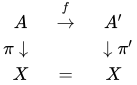
Let be a category and a fixed object of [1]pg 59. The overcategory (also called a slice category) is an associated category whose objects are pairs where is a morphism in . Then, a morphism between objects is given by a morphism in the category such that the following diagram commutes




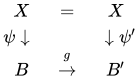
There is a dual notion called the undercategory (also called a coslice category) whose objects are pairs where is a morphism in . Then, morphisms in are given by morphisms in such that the following diagram commutes


These two notions have generalizations in 2-category theory[2] and higher category theory[3]pg 43, with definitions either analogous or essentially the same.
Properties
Many categorical properties of are inherited by the associated over and undercategories for an object . For example, if has finite products and coproducts, it is immediate the categories and have these properties since the product and coproduct can be constructed in , and through universal properties, there exists a unique morphism either to or from . In addition, this applies to limits and colimits as well.
By construction, is a terminal object of and an initial object of .

Examples
Overcategories on a site
Recall that a site is a categorical generalization of a topological space first introduced by Grothendieck. One of the canonical examples comes directly from topology, where the category whose objects are open subsets of some topological space , and the morphisms are given by inclusion maps. Then, for a fixed open subset , the overcategory is canonically equivalent to the category for the induced topology on . This is because every object in is an open subset contained in .


Category of algebras as an undercategory
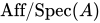
The category of commutative -algebras is equivalent to the undercategory for the category of commutative rings. This is because the structure of an -algebra on a commutative ring is directly encoded by a ring morphism . If we consider the opposite category, it is an overcategory of affine schemes, , or just .



Overcategories of spaces
Another common overcategory considered in the literature are overcategories of spaces, such as schemes, smooth manifolds, or topological spaces. These categories encode objects relative to a fixed object, such as the category of schemes over , . Fiber products in these categories can be considered intersections (e.g. the scheme-theoretic intersection), given the objects are subobjects of the fixed object.


References
- ^ Leinster, Tom (2016-12-29). "Basic Category Theory". arXiv:1612.09375 [math.CT].
- ^ "Section 4.32 (02XG): Categories over categories—The Stacks project". stacks.math.columbia.edu. Retrieved 2020-10-16.
- ^ Lurie, Jacob (2008-07-31). "Higher Topos Theory". arXiv:math/0608040.
|  | |||||||||||||||||
|


Content Disclaimer
Informasi ini disarikan dari Wikipedia dan disajikan kembali untuk tujuan edukasi. Konten tersedia di bawah lisensi CC BY-SA 3.0. Kami tidak bertanggung jawab atas ketidakakuratan data yang bersumber dari kontribusi publik tersebut.
- The information displayed on this website is sourced in part or in whole from Wikipedia and has been adapted for the purpose of restating it. We strive to provide accurate and relevant information, however:
- There is no guarantee of absolute accuracy. Wikipedia is an open, collaborative project that can be edited by anyone, so information is subject to change.
- It is not intended to constitute professional advice. The content displayed is for informational and educational purposes only. For important decisions (e.g., medical, legal, or financial), please consult a professional.
- Content copyright. Wikipedia is licensed under the Creative Commons Attribution-ShareAlike License (CC BY-SA). This means that content may be reused with appropriate attribution and shared under a similar license.
- Responsible use. Any risk arising from the use of information from this website is entirely the responsibility of the user.