Orangequit
| Orangequit | |
|---|---|

| |
| Male | |
Scientific classification 
| |
| Kingdom: | Animalia |
| Phylum: | Chordata |
| Class: | Aves |
| Order: | Passeriformes |
| Family: | Thraupidae |
| Genus: | Euneornis Fitzinger, 1856 |
| Species: | E. campestris
|
| Binomial name | |
| Euneornis campestris | |

| |
| range | |
| Synonyms | |
|
Motacilla campestris (protonym) | |

The orangequit (Euneornis campestris) is a species of passerine bird in the tanager family Thraupidae and is the only member of the genus Euneornis. It is endemic to Jamaica where its natural habitats are subtropical or tropical moist lowland forests and heavily degraded former forest.
Breeding
The orangequit's breeding season is between the months of April and June. The species will build nests out of grass and plant fiber and place them in trees almost six meters above the ground. The female will typically lay 2–4 eggs at a time and will incubate. The appearance differs according to their sex and age.
Taxonomy
The orangequit was formally described by the Swedish naturalist Carl Linnaeus in 1758 in the tenth edition of his Systema Naturae under the binomial name Motacilla campestris.[2] Linnaeus based his description on the "American Hedge-Sparrow" that George Edwards had described and illustrated in his 1750 work, A Natural History of Uncommon Birds, from a specimen collected in Jamaica.[3] The species was moved to the genus Euneornis by the Austrian zoologist Leopold Fitzinger in 1856.[4] The genus name Euneornis combines the Ancient Greek eu meaning "good" with the genus Neornis introduced by Edward Blyth in 1845 and now a junior synonym of Cettia. The specific epithet campestris is Latin and means "of the fields".[5][6] The species is monotypic: no subspecies are recognised.[7]
Its common name is derived from its orange throat and the English word quit, which refers to small passerines of tropical America; cf. grassquit, bananaquit.[8]
Gallery
-
 Male at Negril
 -
 Male at Geejam
 -
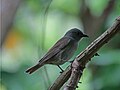 Female at Negril
 -
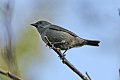 Female at Marshall's Pen

.jpg)

_(8082119181).jpg)
References
- ^ BirdLife International (2016). "Euneornis campestris". IUCN Red List of Threatened Species. 2016 e.T22723722A94830296. doi:10.2305/IUCN.UK.2016-3.RLTS.T22723722A94830296.en. Retrieved 13 November 2021.
- ^ Linnaeus, Carl (1758). Systema Naturae per regna tria naturae, secundum classes, ordines, genera, species, cum characteribus, differentiis, synonymis, locis (in Latin). Vol. 1 (10th ed.). Holmiae (Stockholm): Laurentii Salvii. p. 184.
- ^ Edwards, George (1750). A Natural History of Uncommon Birds. Vol. Part 3. London: Printed for the author at the College of Physicians. p. 122, Plate 122 fig. 2.
- ^ Fitzinger, Leopold (1856). "Über das System und die Charakteristik der natürlichen Familien der Vögel". Sitzungsberichte der Kaiserlichen Akademie der Wissenschaften. Mathematisch-Naturwissenschaftliche Classe. 21: 277–318 [316].
- ^ Mayr, Ernst; Cottrell, G. William, eds. (1986). Check-List of Birds of the World. Vol. 11. Cambridge, Massachusetts: Museum of Comparative Zoology. p. 8.
- ^ Jobling, James A. (2010). The Helm Dictionary of Scientific Bird Names. London: Christopher Helm. pp. 87, 268. ISBN 978-1-4081-2501-4.
- ^ Gill, Frank; Donsker, David; Rasmussen, Pamela, eds. (July 2020). "Tanagers and allies". IOC World Bird List Version 10.2. International Ornithologists' Union. Retrieved 15 November 2020.
- ^ Reedman, R. (2016). Lapwings, Loons and Lousy Jacks: The How and Why of Bird Names. United Kingdom: Pelagic Publishing.
- Raffaele, Herbert; James Wiley, Orlando Garrido, Allan Keith & Janis Raffaele (2003) Birds of the West Indies, Christopher Helm, London.
Content Disclaimer
Informasi ini disarikan dari Wikipedia dan disajikan kembali untuk tujuan edukasi. Konten tersedia di bawah lisensi CC BY-SA 3.0. Kami tidak bertanggung jawab atas ketidakakuratan data yang bersumber dari kontribusi publik tersebut.
- The information displayed on this website is sourced in part or in whole from Wikipedia and has been adapted for the purpose of restating it. We strive to provide accurate and relevant information, however:
- There is no guarantee of absolute accuracy. Wikipedia is an open, collaborative project that can be edited by anyone, so information is subject to change.
- It is not intended to constitute professional advice. The content displayed is for informational and educational purposes only. For important decisions (e.g., medical, legal, or financial), please consult a professional.
- Content copyright. Wikipedia is licensed under the Creative Commons Attribution-ShareAlike License (CC BY-SA). This means that content may be reused with appropriate attribution and shared under a similar license.
- Responsible use. Any risk arising from the use of information from this website is entirely the responsibility of the user.