Nowhere continuous function
 | This article needs additional citations for verification. (September 2012) |
In mathematics, a nowhere continuous function, also called an everywhere discontinuous function, is a function that is not continuous at any point of its domain. If is a function from real numbers to real numbers, then is nowhere continuous if for each point there is some such that for every we can find a point such that and . Therefore, no matter how close it gets to any fixed point, there are even closer points at which the function takes not-nearby values.



More general definitions of this kind of function can be obtained, by replacing the absolute value by the distance function in a metric space, or by using the definition of continuity in a topological space.
Examples
Dirichlet function
One example of such a function is the indicator function of the rational numbers, also known as the Dirichlet function. This function is denoted as and has domain and codomain both equal to the real numbers. By definition, is equal to if is a rational number and it is otherwise.


More generally, if is any subset of a topological space such that both and the complement of are dense in then the real-valued function which takes the value on and on the complement of will be nowhere continuous. Functions of this type were originally investigated by Peter Gustav Lejeune Dirichlet.[1]


Non-trivial additive functions
A function is called an additive function if it satisfies Cauchy's functional equation: For example, every map of form where is some constant, is additive (in fact, it is linear and continuous). Furthermore, every linear map is of this form (by taking ).


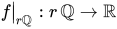
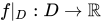
Although every linear map is additive, not all additive maps are linear. An additive map is linear if and only if there exists a point at which it is continuous, in which case it is continuous everywhere. Consequently, every non-linear additive function is discontinuous at every point of its domain. Nevertheless, the restriction of any additive function to any real scalar multiple of the rational numbers is continuous; explicitly, this means that for every real the restriction to the set is a continuous function. Thus if is a non-linear additive function then for every point is discontinuous at but is also contained in some dense subset on which 's restriction is continuous (specifically, take if and take if ).







Discontinuous linear maps
A linear map between two topological vector spaces, such as normed spaces for example, is continuous (everywhere) if and only if there exists a point at which it is continuous, in which case it is even uniformly continuous. Consequently, every linear map is either continuous everywhere or else continuous nowhere. Every linear functional is a linear map and on every infinite-dimensional normed space, there exists some discontinuous linear functional.
Other functions
Conway's base 13 function is discontinuous at every point.
Hyperreal characterisation
A real function is nowhere continuous if its natural hyperreal extension has the property that every is infinitely close to a such that the difference is appreciable (that is, not infinitesimal).

See also
- Blumberg theorem – even if a real function is nowhere continuous, there is a dense subset of such that the restriction of to is continuous.
- Thomae's function (also known as the popcorn function) – a function that is continuous at all irrational numbers and discontinuous at all rational numbers.
- Weierstrass function – a function continuous everywhere (inside its domain) and differentiable nowhere.


References
- ^ Lejeune Dirichlet, Peter Gustav (1829). "Sur la convergence des séries trigonométriques qui servent à représenter une fonction arbitraire entre des limites données". Journal für die reine und angewandte Mathematik. 4: 157–169.
External links
- "Dirichlet-function", Encyclopedia of Mathematics, EMS Press, 2001 [1994]
- Dirichlet Function — from MathWorld
- The Modified Dirichlet Function Archived 2019-05-02 at the Wayback Machine by George Beck, The Wolfram Demonstrations Project.
Content Disclaimer
Informasi ini disarikan dari Wikipedia dan disajikan kembali untuk tujuan edukasi. Konten tersedia di bawah lisensi CC BY-SA 3.0. Kami tidak bertanggung jawab atas ketidakakuratan data yang bersumber dari kontribusi publik tersebut.
- The information displayed on this website is sourced in part or in whole from Wikipedia and has been adapted for the purpose of restating it. We strive to provide accurate and relevant information, however:
- There is no guarantee of absolute accuracy. Wikipedia is an open, collaborative project that can be edited by anyone, so information is subject to change.
- It is not intended to constitute professional advice. The content displayed is for informational and educational purposes only. For important decisions (e.g., medical, legal, or financial), please consult a professional.
- Content copyright. Wikipedia is licensed under the Creative Commons Attribution-ShareAlike License (CC BY-SA). This means that content may be reused with appropriate attribution and shared under a similar license.
- Responsible use. Any risk arising from the use of information from this website is entirely the responsibility of the user.