Normal number (computing)
 | This article needs additional citations for verification. (December 2009) |
| Floating-point formats |
|---|
| IEEE 754 |
|
| Other |
| Alternatives |
| Tapered floating point |
In computing, a normal number is a non-zero number in a floating-point representation which is within the balanced range supported by a given floating-point format: it is a floating point number that can be represented without leading zeros in its significand.
The magnitude of the smallest normal number in a format is given by:

where b is the base (radix) of the format (like common values 2 or 10, for binary and decimal number systems), and depends on the size and layout of the format.

Similarly, the magnitude of the largest normal number in a format is given by
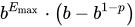
where p is the precision of the format in digits and is related to as:


In the IEEE 754 binary and decimal formats, b, p, , and have the following values:[1]
| Format | Smallest Normal Number | Largest Normal Number | ||||
|---|---|---|---|---|---|---|
| binary16 | 2 | 11 | −14 | 15 | ||
| binary32 | 2 | 24 | −126 | 127 | ||
| binary64 | 2 | 53 | −1022 | 1023 | ||
| binary128 | 2 | 113 | −16382 | 16383 | ||
| decimal32 | 10 | 7 | −95 | 96 | ||
| decimal64 | 10 | 16 | −383 | 384 | ||
| decimal128 | 10 | 34 | −6143 | 6144 |




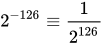
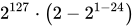
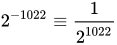

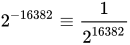

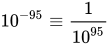

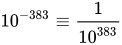

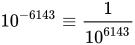

For example, in the smallest decimal format in the table (decimal32), the range of positive normal numbers is 10−95 through 9.999999 × 1096.
Non-zero numbers smaller in magnitude than the smallest normal number are called subnormal numbers (or denormal numbers).
Zero is considered neither normal nor subnormal.
See also
- Normalized number
- Half-precision floating-point format
- Single-precision floating-point format
- Double-precision floating-point format
References
- ^ IEEE Standard for Floating-Point Arithmetic, 2008-08-29, doi:10.1109/IEEESTD.2008.4610935, ISBN 978-0-7381-5752-8
Content Disclaimer
Informasi ini disarikan dari Wikipedia dan disajikan kembali untuk tujuan edukasi. Konten tersedia di bawah lisensi CC BY-SA 3.0. Kami tidak bertanggung jawab atas ketidakakuratan data yang bersumber dari kontribusi publik tersebut.
- The information displayed on this website is sourced in part or in whole from Wikipedia and has been adapted for the purpose of restating it. We strive to provide accurate and relevant information, however:
- There is no guarantee of absolute accuracy. Wikipedia is an open, collaborative project that can be edited by anyone, so information is subject to change.
- It is not intended to constitute professional advice. The content displayed is for informational and educational purposes only. For important decisions (e.g., medical, legal, or financial), please consult a professional.
- Content copyright. Wikipedia is licensed under the Creative Commons Attribution-ShareAlike License (CC BY-SA). This means that content may be reused with appropriate attribution and shared under a similar license.
- Responsible use. Any risk arising from the use of information from this website is entirely the responsibility of the user.