Nitocris II
| Nitocris II | ||||||||||
|---|---|---|---|---|---|---|---|---|---|---|
| High Priestess of Amun in Thebes Divine Adoratrice of Amun? | ||||||||||
| Egyptian name |
hm-ntr [tpy] n-'Imn, Nt-jqrt[1] High Priestess of Amun, Nitocris | |||||||||
| Dynasty | 26th Dynasty | |||||||||
| Pharaoh | Amasis II, Psamtik III | |||||||||
| Father | Amasis II | |||||||||


Nitocris II (or Nitokris II,[1] Nitocris B,[2] Egyptian: Nt-jqrt, Nitiqret) was an ancient Egyptian princess and priestess during the reign of pharaoh Amasis II of the 26th Dynasty.
Biography
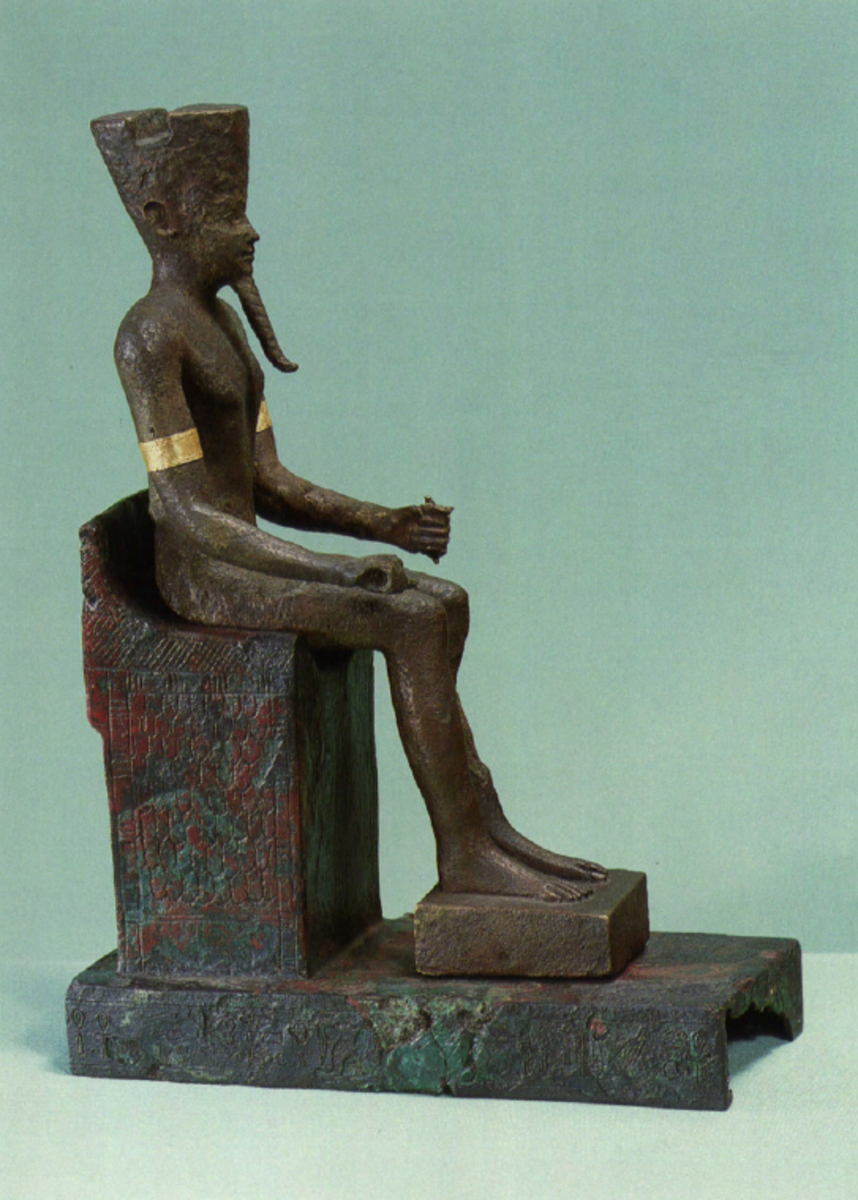
Daughter of Amasis II,[2] Nitocris II is mainly attested by an inscription on a bronze sitting statuette of Amun-Ra now in the University of Chicago Oriental Institute (registration no. E10584A-B[3]) on which she is called High Priest of Amun; the same object also claims that the God's Wife of Amun Ankhnesneferibre was her "mother". Nitocris' title is notable because she is the last attested holder of the once influential office of High Priest of Amun at Thebes, as well as one of only two known female holders;[4] she may have reached this office around 560 BCE.[2]
The fact that Ankhnesneferibre is called her "mother" suggests that Nitocris also held the office of Divine Adoratrice of Amun[1] which usually led to the charge of God's Wife of Amun after the adoptive mother's death. However, it seems that Nitocris never managed to reach the latter position because these offices were abolished soon after the Persian invasion of Egypt in 525 BCE.[5]
References
- ^ a b c Dodson, Aidan (2002). "The problem of Amenirdis II and the heirs of the office of God's Wife of Amun during the Twenty-sixth Dynasty". Journal of Egyptian Archaeology. 88: 179–186. doi:10.1177/030751330208800112. S2CID 190737173. pp. 179; 186
- ^ a b c Kitchen, Kenneth A. (1996). The Third Intermediate Period in Egypt (1100–650 BC). Warminster: Aris & Phillips Limited. p. 608. ISBN 0-85668-298-5. § 365 n. 951; table 13A
- ^ Picture of the statuette on the Chicago Oriental Institute website
- ^ Dodson, Aidan, Hilton, Dyan. The Complete Royal Families of Ancient Egypt. Thames & Hudson (2004). ISBN 0-500-05128-3, p.246
- ^ "God's Wife of Amun". Ancient Egypt by Anneke Bart. Retrieved May 31, 2015.
.png) | This ancient Egypt biographical article is a stub. You can help Wikipedia by adding missing information. |
Content Disclaimer
Informasi ini disarikan dari Wikipedia dan disajikan kembali untuk tujuan edukasi. Konten tersedia di bawah lisensi CC BY-SA 3.0. Kami tidak bertanggung jawab atas ketidakakuratan data yang bersumber dari kontribusi publik tersebut.
- The information displayed on this website is sourced in part or in whole from Wikipedia and has been adapted for the purpose of restating it. We strive to provide accurate and relevant information, however:
- There is no guarantee of absolute accuracy. Wikipedia is an open, collaborative project that can be edited by anyone, so information is subject to change.
- It is not intended to constitute professional advice. The content displayed is for informational and educational purposes only. For important decisions (e.g., medical, legal, or financial), please consult a professional.
- Content copyright. Wikipedia is licensed under the Creative Commons Attribution-ShareAlike License (CC BY-SA). This means that content may be reused with appropriate attribution and shared under a similar license.
- Responsible use. Any risk arising from the use of information from this website is entirely the responsibility of the user.