Negative imaginary systems
 | This article has multiple issues. Please help improve it or discuss these issues on the talk page. (Learn how and when to remove these messages)
|

Negative imaginary (NI) systems theory was introduced by Lanzon and Petersen in.[1][2] A generalization of the theory was presented in [3] In the single-input single-output (SISO) case, such systems are defined by considering the properties of the imaginary part of the frequency response G(jω) and require the system to have no poles in the right half plane and > 0 for all ω in (0, ∞). This means that a system is Negative imaginary if it is both stable and a nyquist plot will have a phase lag between [-π 0] for all ω > 0.

Negative Imaginary Definition
Source:[3]
A square transfer function matrix is NI if the following conditions are satisfied:

- has no pole in .
- For all such that is not a pole of and .
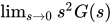
- If is a pole of , then it is a simple pole and furthermore, the residual matrix is Hermitian and positive semidefinite.
- If is a pole of , then for all and is Hermitian and positive semidefinite.
![{\displaystyle Re[s]>0}](https://wikimedia.org/api/rest_v1/media/math/render/svg/5ffcff169369c1b481e587953297da6c47b81c35)








These conditions can be summarized as:
- The system is stable.
- For all positive frequencies, the nyquist diagram of the system response is between [-π 0].
Negative Imaginary Lemma
Source:[3]
Let be a minimal realization of the transfer function matrix . Then, is NI if and only if and there exists a matrix


such that the following LMI is satisfied:


This result comes from positive real theory after converting the negative imaginary system to a positive real system for analysis.
References
- ^ Lanzon, Alexander; Petersen, Ian R. (May 2008). "Stability Robustness of a Feedback Interconnection of Systems With Negative Imaginary Frequency Response". IEEE Transactions on Automatic Control. 53 (4): 1042–1046. arXiv:1401.7739. doi:10.1109/TAC.2008.919567. S2CID 14390957.
- ^ Petersen, Ian; Lanzon, Alexander (October 2010). "Feedback Control of Negative-Imaginary Systems". IEEE Control Systems Magazine. 30 (5): 54–72. arXiv:1401.7745. doi:10.1109/MCS.2010.937676. S2CID 27523861.
- ^ a b c Mabrok, Mohamed A.; Kallapur, Abhijit G.; Petersen, Ian R.; Lanzon, Alexander (October 2014). "Generalizing Negative Imaginary Systems Theory to Include Free Body Dynamics: Control of Highly Resonant Structures With Free Body Motion". IEEE Transactions on Automatic Control. 59 (10): 2692–2707. arXiv:1305.1079. doi:10.1109/TAC.2014.2325692. S2CID 39372589.
Content Disclaimer
Informasi ini disarikan dari Wikipedia dan disajikan kembali untuk tujuan edukasi. Konten tersedia di bawah lisensi CC BY-SA 3.0. Kami tidak bertanggung jawab atas ketidakakuratan data yang bersumber dari kontribusi publik tersebut.
- The information displayed on this website is sourced in part or in whole from Wikipedia and has been adapted for the purpose of restating it. We strive to provide accurate and relevant information, however:
- There is no guarantee of absolute accuracy. Wikipedia is an open, collaborative project that can be edited by anyone, so information is subject to change.
- It is not intended to constitute professional advice. The content displayed is for informational and educational purposes only. For important decisions (e.g., medical, legal, or financial), please consult a professional.
- Content copyright. Wikipedia is licensed under the Creative Commons Attribution-ShareAlike License (CC BY-SA). This means that content may be reused with appropriate attribution and shared under a similar license.
- Responsible use. Any risk arising from the use of information from this website is entirely the responsibility of the user.