Needle holder


A needle holder, also called needle driver or needle forceps, is a surgical instrument similar to a hemostat, used by doctors and surgeons to hold and push a suturing needle when performing wound closure, ligation and other surgical procedures that require re-anastomosis.
Being specialized forceps, the components of a typical needle holder are the jaws (often reinforced with tungsten carbide inserts), the hinged joint and the handles (typically with finger rings at the end). Most needle holders also have a ratchet mechanism that locks the handles together and clamps the needle firmly between the jaws, allowing the user to maneuver the needle through various tissues without having to keep squeezing the grip. To maintain a firm grip on the needle, the jaws are often textured and short compared to the handles (increasing the mechanical advantage using the principle of a lever).
Most needle holders are designed to be gripped with the fingers and palm like scissors. However, some are designed for a tweezers-like grip to allow finer, more precise movements around delicate structures or narrow spaces. An example of such is the Castroviejo needle holder (named after Spanish American eye surgeon Ramón Castroviejo), which is commonly used in eye surgery, microsurgery and dental surgery.
-
 Mayo-Hegar needle driver
 -
 Close-up of a Mayo-Hegar needle driver showing its locking ratchet mechanism
 -
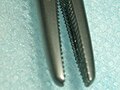 Close-up of a needle driver showing the cross-serrated teeth of its jaws


References
- Chih-Chang Chu; J. Anthony von Fraunhofer; Howard P. Greisler (20 December 1996). Wound Closure Biomaterials and Devices. CRC Press. pp. 35–. ISBN 978-0-8493-4964-5.

Content Disclaimer
Informasi ini disarikan dari Wikipedia dan disajikan kembali untuk tujuan edukasi. Konten tersedia di bawah lisensi CC BY-SA 3.0. Kami tidak bertanggung jawab atas ketidakakuratan data yang bersumber dari kontribusi publik tersebut.
- The information displayed on this website is sourced in part or in whole from Wikipedia and has been adapted for the purpose of restating it. We strive to provide accurate and relevant information, however:
- There is no guarantee of absolute accuracy. Wikipedia is an open, collaborative project that can be edited by anyone, so information is subject to change.
- It is not intended to constitute professional advice. The content displayed is for informational and educational purposes only. For important decisions (e.g., medical, legal, or financial), please consult a professional.
- Content copyright. Wikipedia is licensed under the Creative Commons Attribution-ShareAlike License (CC BY-SA). This means that content may be reused with appropriate attribution and shared under a similar license.
- Responsible use. Any risk arising from the use of information from this website is entirely the responsibility of the user.