Murray loop bridge


The Murray loop bridge is a bridge circuit used for locating faults in underground or underwater cables.[1][2] It has been used for more than 100 years[3] but is being replaced by the more precise time-domain reflectometer.
One end of the faulted cable is connected through a pair of resistors to the voltage source. Also a null detector is connected. The other end of the cable is shorted. The bridge is brought to balance by changing the values of RB1 and RB2, which is achieved when:
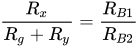
which is equivalent to:
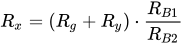
The value of resistance Rx is proportional the length Lx, thus the location of the fault can be calculated:
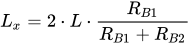
where L is the total length of the cable under test - a value proportional to Rg.
The method assumes a single fault exists, of low resistance compared with the undamaged cable insulation resistance, and that the cable conductors have uniform resistance per unit length.
Varley loop
The similar Varley loop uses fixed resistors for RB1 and RB2, and inserts a variable resistor in the faulted leg. Test sets for cable testing can be connected for either bridge technique. If the fault resistance is high, the sensitivity of the Murray bridge is reduced and the Varley loop may be more suitable.
See also
References
- ^ "Science Links Japan | Development of Murray Loop Bridge for High Induced Voltage". sciencelinks.jp. Archived from the original on February 17, 2012.
- ^ https://www.jstage.jst.go.jp/article/ieejpes/123/11/123_11_1411/_pdf Development of Murray Loop Bridge for High Induced Voltage (PDF) [2509K] (Japanese)
- ^ Latimer Clark, Robert Sabine Electrical tables and formulæ: for use of telegraph inspectors and operators, E. & F.N. Spon, 1871 pp. 41-44
Content Disclaimer
Informasi ini disarikan dari Wikipedia dan disajikan kembali untuk tujuan edukasi. Konten tersedia di bawah lisensi CC BY-SA 3.0. Kami tidak bertanggung jawab atas ketidakakuratan data yang bersumber dari kontribusi publik tersebut.
- The information displayed on this website is sourced in part or in whole from Wikipedia and has been adapted for the purpose of restating it. We strive to provide accurate and relevant information, however:
- There is no guarantee of absolute accuracy. Wikipedia is an open, collaborative project that can be edited by anyone, so information is subject to change.
- It is not intended to constitute professional advice. The content displayed is for informational and educational purposes only. For important decisions (e.g., medical, legal, or financial), please consult a professional.
- Content copyright. Wikipedia is licensed under the Creative Commons Attribution-ShareAlike License (CC BY-SA). This means that content may be reused with appropriate attribution and shared under a similar license.
- Responsible use. Any risk arising from the use of information from this website is entirely the responsibility of the user.