Generalization of the Euler gamma function and the Barnes G-function
For derivatives of the log of the gamma function, see polygamma function.
Plot of the Barnes G aka double gamma function G(z) in the complex plane from -2-2i to 2+2i with colors created with Mathematica 13.1 function ComplexPlot3D
In mathematics, the multiple gamma function is a generalization of the Euler gamma function and the Barnes G-function. The double gamma function was studied by Barnes (1901). At the end of this paper he mentioned the existence of multiple gamma functions generalizing it, and studied these further in Barnes (1904).
where is the Barnes zeta function. (This differs by a constant from Barnes's original definition.)
Properties
Considered as a meromorphic function of , has no zeros. It has poles at for non-negative integers . These poles are simple unless some of them coincide. Up to multiplication by the exponential of a polynomial, is the unique meromorphic function of finite order with these zeros and poles.
In the case of the double Gamma function, the asymptotic behaviour for is known, and the leading factor is[1]
Infinite product representation
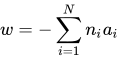
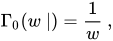
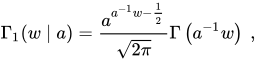
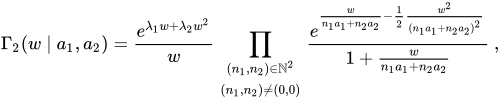
The multiple gamma function has an infinite product representation that makes it manifest that it is meromorphic, and that also makes the positions of its poles manifest. In the case of the double gamma function, this representation is [2]
Barnes, E. W. (1901), "The Theory of the Double Gamma Function", Philosophical Transactions of the Royal Society of London. Series A, Containing Papers of a Mathematical or Physical Character, 196 (274–286): 265–387, Bibcode:1901RSPTA.196..265B, doi:10.1098/rsta.1901.0006, ISSN0264-3952, JSTOR90809
Barnes, E. W. (1904), "On the theory of the multiple gamma function", Trans. Camb. Philos. Soc., 19: 374–425
Informasi ini disarikan dari Wikipedia dan disajikan kembali untuk tujuan edukasi. Konten tersedia di bawah lisensi CC BY-SA 3.0. Kami tidak bertanggung jawab atas ketidakakuratan data yang bersumber dari kontribusi publik tersebut.
The information displayed on this website is sourced in part or in whole from Wikipedia and has been adapted for the purpose of restating it. We strive to provide accurate and relevant information, however:
There is no guarantee of absolute accuracy. Wikipedia is an open, collaborative project that can be edited by anyone, so information is subject to change.
It is not intended to constitute professional advice. The content displayed is for informational and educational purposes only. For important decisions (e.g., medical, legal, or financial), please consult a professional.
Content copyright. Wikipedia is licensed under the Creative Commons Attribution-ShareAlike License (CC BY-SA). This means that content may be reused with appropriate attribution and shared under a similar license.
Responsible use. Any risk arising from the use of information from this website is entirely the responsibility of the user.
_in_the_complex_plane_from_-2-2i_to_2%2B2i_with_colors_created_with_Mathematica_13.1_function_ComplexPlot3D.svg)









![{\displaystyle \Gamma _{2}(w|a_{1},a_{2})\ {\underset {w\to \infty }{\sim }}\ w^{\frac {w^{2}}{2a_{1}a_{2}}}\quad {\text{for}}\quad \left\{{\begin{array}{l}{\frac {a_{1}}{a_{2}}}\in \mathbb {C} \backslash (-\infty ,0]\ ,\\w\in \mathbb {C} \backslash \left(\mathbb {R} _{+}a_{1}+\mathbb {R} _{+}a_{2}\right)\ .\end{array}}\right.}](https://wikimedia.org/api/rest_v1/media/math/render/svg/464bdd4f68cb018e864d0e4ee92471e84e9bf707)









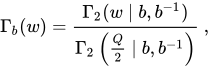




![{\displaystyle \log \Gamma _{b}(w)=\int _{0}^{\infty }{\frac {dt}{t}}\left[{\frac {e^{-wt}-e^{-{\frac {Q}{2}}t}}{(1-e^{-bt})(1-e^{-b^{-1}t})}}-{\frac {\left({\frac {Q}{2}}-w\right)^{2}}{2}}e^{-t}-{\frac {{\frac {Q}{2}}-w}{t}}\right]\ .}](https://wikimedia.org/api/rest_v1/media/math/render/svg/d5d6dd66b08ad191b07aebe164e187d85f997071)





![{\displaystyle \log S_{b}(w)=\int _{0}^{\infty }{\frac {dt}{t}}\left[{\frac {\sinh \left({\frac {Q}{2}}-w\right)t}{2\sinh \left({\frac {1}{2}}bt\right)\sinh \left({\frac {1}{2}}b^{-1}t\right)}}-{\frac {Q-2w}{t}}\right]\ ,}](https://wikimedia.org/api/rest_v1/media/math/render/svg/51f56f13639f71e532a44af524717103306d57bd)
![{\displaystyle \log \Upsilon _{b}(w)=\int _{0}^{\infty }{\frac {dt}{t}}\left[\left({\frac {Q}{2}}-w\right)^{2}e^{-t}-{\frac {\sinh ^{2}{\frac {1}{2}}\left({\frac {Q}{2}}-w\right)t}{\sinh \left({\frac {1}{2}}bt\right)\sinh \left({\frac {1}{2}}b^{-1}t\right)}}\right]\ .}](https://wikimedia.org/api/rest_v1/media/math/render/svg/bd97cc7b34cc7565f9396265a4d91f58504cce72)


