Mu problem
In theoretical physics, the μ problem is a problem of supersymmetric theories, concerned with understanding the parameters of the theory.
Background
The supersymmetric Higgs mass parameter μ appears as the following term in the superpotential: μ Hu Hd. It is necessary to provide a mass for the fermionic superpartners of the Higgs bosons, i.e. the higgsinos, and it enters as well the scalar potential of the Higgs bosons.
To ensure that Hu and Hd get a non-zero vacuum expectation value after electroweak symmetry breaking, μ should be of the order of magnitude of the electroweak scale, many orders of magnitude smaller than the Planck scale (Mpl), which is the natural cutoff scale. This brings about a problem of naturalness: Why is that scale so much smaller than the cutoff scale? And why, if the μ term in the superpotential has different physical origins, do the corresponding scale happen to fall so close to each other?
Before LHC, it was thought that the soft supersymmetry breaking terms should also be of the same order of magnitude as the electroweak scale. This was negated by the Higgs mass measurements and limits on supersymmetry models.[1]
One proposed solution, known as the Giudice–Masiero mechanism,[2] is that this term does not appear explicitly in the Lagrangian, because it violates some global symmetry, and can therefore be created only via spontaneous breaking of this symmetry. This is proposed to happen together with F-term supersymmetry breaking, with a spurious field X that parameterizes the hidden supersymmetry-breaking sector of the theory (meaning that FX is the non-zero F-term).
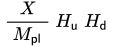
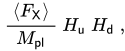
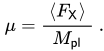
Let us assume that the Kahler potential includes a term of the form times some dimensionless coefficient, which is naturally of order one, and where Mpl is Planck mass. Then as supersymmetry breaks, FX gets a non-zero vacuum expectation value ⟨FX⟩ and the following effective term is added to the superpotential: which gives a measured On the other hand, soft supersymmetry breaking terms are similarly created and also have a natural scale of

See also
- NMSSM (Next-to-Minimal Supersymmetric Standard Model)
- Minimal Supersymmetric Standard Model
- Doublet–triplet splitting problem
- Hierarchy problem
- Little hierarchy problem
References
- ^ Fowlie, Andrew (2014). "Is the CNMSSM more credible than the CMSSM?". The European Physical Journal C. 74 (10): 3105. arXiv:1407.7534. Bibcode:2014EPJC...74.3105F. doi:10.1140/epjc/s10052-014-3105-y. S2CID 119304794.
- ^ Giudice, G.F.; Masiero, A. (1988). "A natural solution to the mu problem in supergravity theories". Physics Letters B. 206 (3): 480–484. Bibcode:1988PhLB..206..480G. doi:10.1016/0370-2693(88)91613-9.
External links
 | This quantum mechanics–related article is a stub. You can help Wikipedia by adding missing information. |
Content Disclaimer
Informasi ini disarikan dari Wikipedia dan disajikan kembali untuk tujuan edukasi. Konten tersedia di bawah lisensi CC BY-SA 3.0. Kami tidak bertanggung jawab atas ketidakakuratan data yang bersumber dari kontribusi publik tersebut.
- The information displayed on this website is sourced in part or in whole from Wikipedia and has been adapted for the purpose of restating it. We strive to provide accurate and relevant information, however:
- There is no guarantee of absolute accuracy. Wikipedia is an open, collaborative project that can be edited by anyone, so information is subject to change.
- It is not intended to constitute professional advice. The content displayed is for informational and educational purposes only. For important decisions (e.g., medical, legal, or financial), please consult a professional.
- Content copyright. Wikipedia is licensed under the Creative Commons Attribution-ShareAlike License (CC BY-SA). This means that content may be reused with appropriate attribution and shared under a similar license.
- Responsible use. Any risk arising from the use of information from this website is entirely the responsibility of the user.