Mogons
 | This article needs additional citations for verification. (May 2017) |
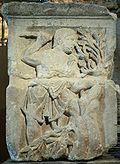
Mogons or Moguns was a Celtic god worshiped in Roman Britain and Gaul. The main evidence is from altars dedicated to the god by Roman soldiers.
Etymology
According to J.T. Koch at the University of Wales, the various alternations of the name Moguns derive from the Romano-Celtic dialectal reflexes of Proto-Celtic *mogont-s (a derivative of the Proto-Indo-European root *megH2- "to be great, mighty"), an Indo-European *-nt- -stem cognate with Sanskrit mahānt and Avestan mazant ‘great’.[1]
Centres of worship
Altar-stones raised to Mogon, with varied spellings, have been recovered in Great Britain, such as the stones found at the following locations.[2] The number is the catalog number of the artifact and the name in parentheses is the word as it appears on the stone, not necessarily (and probably not) in the nominative case. Most are datives, to be translated as "to the god":
- Voreda (Old Penrith): 921 (Mogti), 922 (Mounti)
- Castra Exploratorum (Netherby, Cumbria): 971 (Mogont Vitire)
- Habitancum (Risingham): 1225 (Mogonito, dative of *Mogonitus, adjective formed from *Mogons),[3] 1226 (Mouno, *Moguno, dative of *Mogunus)
- Bremenium (High Rochester): 1269 (Mountibus, *Moguntibus, dative plural of *Moguns)
- Vindolanda (Chesterholm): 1722d (Mogunti et Genio Loci).
Modern Mainz takes its name from Castrum Moguntiacum, a Roman base placed there. It is hypothesized that Moguns gave his name to it. The inscription at Habitancum identifies the troops stationed at that location as being from the Vangiones, the Gaesati and Rhaeti from Germania Superior. Mainz was in the territory of the Aresaces, a Celtic tribe probably part of the Treveri.
The Habitancum inscription contains also the expression Deo Mogonito Cad... with the letters following Cad missing. As the region is in the territory of the historic Scottish tribe called the Gadeni, centered around Jedburgh (Jed possibly from Cad), the Cad.. is interpreted as some case of Cadeni. One speculation is that the Cadeni were a section of the Vangiones. Some derive Cadeni from Gaedhal, or Gael. A third theory derives Cad from catu-, "battle", with a sense "to the battle god, Mogon...".[citation needed]
Locations of artifacts
References
- ^ Koch, J.T. (2005:1300) Celtic Culture: A Historical Encyclopedia ABC-CLIO Ltd (15 Mar 2006); 978-1851094400
- ^ Birley, Eric (1986). "The Deities of Roman Britain". In Wolfgang Haase (ed.). Aufstieg und Niedergang der römischen Welt (ANRW) [Rise and Decline of the Roman World]. Vol. 18/1. Teilband Religion (Heidentum: Die religiösen Verhältnisse in den Provinzen). Berlin, Boston: De Gruyter. pp. 3–112 [52]. doi:10.1515/9783110861464-002. ISBN 978-3-11-086146-4.
- ^ "Bretagne". L'Année Épigraphique (in French). 1975: 137–48 [147 (entry nr. 580)]. 1978. JSTOR 25607071.
External links

Content Disclaimer
Informasi ini disarikan dari Wikipedia dan disajikan kembali untuk tujuan edukasi. Konten tersedia di bawah lisensi CC BY-SA 3.0. Kami tidak bertanggung jawab atas ketidakakuratan data yang bersumber dari kontribusi publik tersebut.
- The information displayed on this website is sourced in part or in whole from Wikipedia and has been adapted for the purpose of restating it. We strive to provide accurate and relevant information, however:
- There is no guarantee of absolute accuracy. Wikipedia is an open, collaborative project that can be edited by anyone, so information is subject to change.
- It is not intended to constitute professional advice. The content displayed is for informational and educational purposes only. For important decisions (e.g., medical, legal, or financial), please consult a professional.
- Content copyright. Wikipedia is licensed under the Creative Commons Attribution-ShareAlike License (CC BY-SA). This means that content may be reused with appropriate attribution and shared under a similar license.
- Responsible use. Any risk arising from the use of information from this website is entirely the responsibility of the user.