Modulo-N code
 | This article relies largely or entirely on a single source. (October 2025) |
Modulo-N code is a lossy compression algorithm used to compress correlated data sources using modular arithmetic.
Compression
When applied to two nodes in a network whose data are in close range of each other modulo-N code requires one node (say odd) to send the coded data value as the raw data ; the even node is required to send the coded data as the . Hence the name modulo-N code.


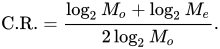
Since at least bits are required to represent a number K in binary, the modulo coded data of the two nodes requires bits. As we can generally expect always, because . This is how compression is achieved.[1]




A compression ratio achieved is
Decompression
At the receiver, by joint decoding, we may complete the process of extracting the data and rebuilding the original values. The code from the even node is reconstructed by the assumption that it must be close to the data from the odd node. Hence the decoding algorithm retrieves even node data as

The decoder essentially finds the closest match to and the decoded value is declared as


Example
For a mod-8 code, we have Encoder
D_o=43,D_e=47
M_o=43,M_e=47 mod(8) = 7,
Decoder
M_o=43,M_e=47 mod(8) = 7,
D_o=43,D_e=CLOSEST(43,8⋅k + 7)
D_o=43,D_e=47

Modulo-N decoding is similar to phase unwrapping and has the same limitation: If the difference from one node to the next is more than N/2 (if the phase changes from one sample to the next more than ), then decoding leads to an incorrect value.

See also
- DISCUS is a more sophisticated technique for compressing correlated data sources.
- Delta encoding is a related algorithm used in lossless compression algorithms designed for correlated data sources.
References
- ^ Franco, Fernando (2021-08-27). "Three effective ways to create modulo n integer sequences". Franco Fernando. Retrieved 2025-09-21.
Content Disclaimer
Informasi ini disarikan dari Wikipedia dan disajikan kembali untuk tujuan edukasi. Konten tersedia di bawah lisensi CC BY-SA 3.0. Kami tidak bertanggung jawab atas ketidakakuratan data yang bersumber dari kontribusi publik tersebut.
- The information displayed on this website is sourced in part or in whole from Wikipedia and has been adapted for the purpose of restating it. We strive to provide accurate and relevant information, however:
- There is no guarantee of absolute accuracy. Wikipedia is an open, collaborative project that can be edited by anyone, so information is subject to change.
- It is not intended to constitute professional advice. The content displayed is for informational and educational purposes only. For important decisions (e.g., medical, legal, or financial), please consult a professional.
- Content copyright. Wikipedia is licensed under the Creative Commons Attribution-ShareAlike License (CC BY-SA). This means that content may be reused with appropriate attribution and shared under a similar license.
- Responsible use. Any risk arising from the use of information from this website is entirely the responsibility of the user.