Mixed binomial process
A mixed binomial process is a special point process in probability theory. They naturally arise from restrictions of (mixed) Poisson processes bounded intervals.
Definition
Let be a probability distribution and let be i.i.d. random variables with distribution . Let be a random variable taking a.s. (almost surely) values in . Assume that are independent and let denote the Dirac measure on the point .





Then a random measure is called a mixed binomial process iff it has a representation as


This is equivalent to conditionally on being a binomial process based on and .[1]


Properties
Laplace transform
Conditional on , a mixed Binomial processe has the Laplace transform


for any positive, measurable function .

Restriction to bounded sets
For a point process and a bounded measurable set define the restriction of on as

- .

Mixed binomial processes are stable under restrictions in the sense that if is a mixed binomial process based on and , then is a mixed binomial process based on

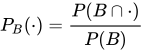
and some random variable .

Also if is a Poisson process or a mixed Poisson process, then is a mixed binomial process.[2]
Examples
Poisson-type random measures are a family of three random counting measures which are closed under restriction to a subspace, i.e. closed under thinning, that are examples of mixed binomial processes. They are the only distributions in the canonical non-negative power series family of distributions to possess this property and include the Poisson distribution, negative binomial distribution, and binomial distribution. Poisson-type (PT) random measures include the Poisson random measure, negative binomial random measure, and binomial random measure.[3]
References
- ^ Kallenberg, Olav (2017). Random Measures, Theory and Applications. Switzerland: Springer. p. 72. doi:10.1007/978-3-319-41598-7. ISBN 978-3-319-41596-3.
- ^ Kallenberg, Olav (2017). Random Measures, Theory and Applications. Switzerland: Springer. p. 77. doi:10.1007/978-3-319-41598-7. ISBN 978-3-319-41596-3.
- ^ Caleb Bastian, Gregory Rempala. Throwing stones and collecting bones: Looking for Poisson-like random measures, Mathematical Methods in the Applied Sciences, 2020. doi:10.1002/mma.6224
Content Disclaimer
Informasi ini disarikan dari Wikipedia dan disajikan kembali untuk tujuan edukasi. Konten tersedia di bawah lisensi CC BY-SA 3.0. Kami tidak bertanggung jawab atas ketidakakuratan data yang bersumber dari kontribusi publik tersebut.
- The information displayed on this website is sourced in part or in whole from Wikipedia and has been adapted for the purpose of restating it. We strive to provide accurate and relevant information, however:
- There is no guarantee of absolute accuracy. Wikipedia is an open, collaborative project that can be edited by anyone, so information is subject to change.
- It is not intended to constitute professional advice. The content displayed is for informational and educational purposes only. For important decisions (e.g., medical, legal, or financial), please consult a professional.
- Content copyright. Wikipedia is licensed under the Creative Commons Attribution-ShareAlike License (CC BY-SA). This means that content may be reused with appropriate attribution and shared under a similar license.
- Responsible use. Any risk arising from the use of information from this website is entirely the responsibility of the user.