Microactuator
 | This article needs additional citations for verification. (November 2025) |
A microactuator is a microscopic servomechanism that supplies and transmits a measured amount of energy for the operation of another mechanism or system. As a general actuator, following standards have to be met:
- Large travel
- High precision
- Fast switching
- Low power consumption
- Power free force sustainability
For microactuator, there are two in addition
- Microstructurability
- Integrability
Principle of microactuators
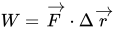
The basic principle can be described as the expression for mechanical work
since an actuator is to manipulate positions and therefore force is needed. For different kind of microactuators, different physical principles are applied.
Classes of microactuators
See also
- Newton's laws
- Euler–Bernoulli beam equation
- Electrostatics
- Electromagnetism
- Piezoelectricity
- Microfluidics
- Sensors
- Nanotube nanomotor
References
- ^ Fujita, Hiroyuki; Toshiyoshi, Hiroshi (1998). "Micro actuators and their applications". Microelectronics Journal. 29 (9): 637–640. doi:10.1016/S0026-2692(98)00027-5.
- ^ Wood, D.; Burdess, J. S.; Harris, A. J. (1996). "Actuators and their mechanisms in microengineering". IEE Colloquium on Actuator Technology: Current Practice and New Developments (Digest No: 1996/110): 7/1–7/3. doi:10.1049/ic:19960698.
- ^ Ma, Z. C.; Fan, J.; Wang, H.; Chen, W.; Yang, G. Z.; Han, B. (2023). "Microfluidic Approaches for Microactuators: From Fabrication, Actuation, to Functionalization". Small. 19 (22). doi:10.1002/smll.202300469. PMID 36855777.
- ^ Yoshida, K.; Park, J. H.; Yano, H.; Yokota, S.; Yun, S. (2005). "Study of Valve-Integrated Microactuator Using Homogeneous Electro-Rheological Fluid" (PDF). Sensors and Materials. 17 (3): 97–112.
| National | |
|---|---|
| Other | |

Content Disclaimer
Informasi ini disarikan dari Wikipedia dan disajikan kembali untuk tujuan edukasi. Konten tersedia di bawah lisensi CC BY-SA 3.0. Kami tidak bertanggung jawab atas ketidakakuratan data yang bersumber dari kontribusi publik tersebut.
- The information displayed on this website is sourced in part or in whole from Wikipedia and has been adapted for the purpose of restating it. We strive to provide accurate and relevant information, however:
- There is no guarantee of absolute accuracy. Wikipedia is an open, collaborative project that can be edited by anyone, so information is subject to change.
- It is not intended to constitute professional advice. The content displayed is for informational and educational purposes only. For important decisions (e.g., medical, legal, or financial), please consult a professional.
- Content copyright. Wikipedia is licensed under the Creative Commons Attribution-ShareAlike License (CC BY-SA). This means that content may be reused with appropriate attribution and shared under a similar license.
- Responsible use. Any risk arising from the use of information from this website is entirely the responsibility of the user.