Michell solution
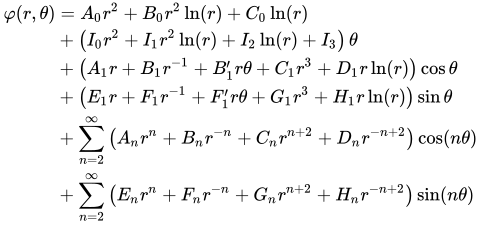
In continuum mechanics, the Michell solution is a general solution to the elasticity equations in polar coordinates () developed by John Henry Michell in 1899.[1] The solution is such that the stress components are in the form of a Fourier series in .


Michell showed that the general solution can be expressed in terms of an Airy stress function of the form The terms and define a trivial null state of stress and are ignored.


Stress components
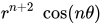
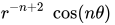
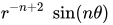
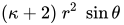
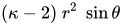
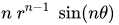
The stress components can be obtained by substituting the Michell solution into the equations for stress in terms of the Airy stress function (in cylindrical coordinates). A table of stress components is shown below.[2]































Displacement components
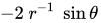
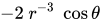
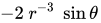
Displacements can be obtained from the Michell solution by using the stress-strain and strain-displacement relations. A table of displacement components corresponding the terms in the Airy stress function for the Michell solution is given below. In this table

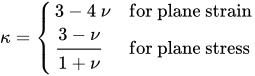
where is the Poisson's ratio, and is the shear modulus.



![{\displaystyle {\frac {1}{2}}[(\kappa -1)\theta ~\cos \theta +\{1-(\kappa +1)\ln r\}~\sin \theta ]\,}](https://wikimedia.org/api/rest_v1/media/math/render/svg/72d52f8fbf58d30a9ced87e77083af68e7b73f75)
![{\displaystyle -{\frac {1}{2}}[(\kappa -1)\theta ~\sin \theta +\{1+(\kappa +1)\ln r\}~\cos \theta ]\,}](https://wikimedia.org/api/rest_v1/media/math/render/svg/1c8660b2da72a1b66968da214f52e32d37d34151)
![{\displaystyle {\frac {1}{2}}[(\kappa +1)\theta ~\sin \theta -\{1-(\kappa -1)\ln r\}~\cos \theta ]\,}](https://wikimedia.org/api/rest_v1/media/math/render/svg/ce23838da9a43c20d63e5b7cd0f409e4093909e7)
![{\displaystyle {\frac {1}{2}}[(\kappa +1)\theta ~\cos \theta -\{1+(\kappa -1)\ln r\}~\sin \theta ]\,}](https://wikimedia.org/api/rest_v1/media/math/render/svg/328058bddbd04de898ee7bd98b3a2585819f1b09)



![{\displaystyle {\frac {1}{2}}[(\kappa -1)\theta ~\sin \theta -\{1-(\kappa +1)\ln r\}~\cos \theta ]\,}](https://wikimedia.org/api/rest_v1/media/math/render/svg/ba2e9838deb55221958680d51ee52d9c253dc91e)
![{\displaystyle {\frac {1}{2}}[(\kappa -1)\theta ~\cos \theta -\{1+(\kappa +1)\ln r\}~\sin \theta ]\,}](https://wikimedia.org/api/rest_v1/media/math/render/svg/61b1cef19ff52eed8609a3627e2f2fbad2d40653)
![{\displaystyle -{\frac {1}{2}}[(\kappa +1)\theta ~\cos \theta +\{1-(\kappa -1)\ln r\}~\sin \theta ]\,}](https://wikimedia.org/api/rest_v1/media/math/render/svg/40ac842a5c3308ac40af79da8a4cdf62e596b419)
![{\displaystyle {\frac {1}{2}}[(\kappa +1)\theta ~\sin \theta +\{1+(\kappa -1)\ln r\}~\cos \theta ]\,}](https://wikimedia.org/api/rest_v1/media/math/render/svg/6fbccd63a7977e2c989b9206fcb0d60913a714eb)














Note that a rigid body displacement can be superposed on the Michell solution of the form

to obtain an admissible displacement field.
See also
References
- ^ Michell, J. H. (1899-04-01). "On the direct determination of stress in an elastic solid, with application to the theory of plates". Proc. London Math. Soc. 31 (1): 100–124. doi:10.1112/plms/s1-31.1.100.
- ^ J. R. Barber, 2002, Elasticity: 2nd Edition, Kluwer Academic Publishers.
Content Disclaimer
Informasi ini disarikan dari Wikipedia dan disajikan kembali untuk tujuan edukasi. Konten tersedia di bawah lisensi CC BY-SA 3.0. Kami tidak bertanggung jawab atas ketidakakuratan data yang bersumber dari kontribusi publik tersebut.
- The information displayed on this website is sourced in part or in whole from Wikipedia and has been adapted for the purpose of restating it. We strive to provide accurate and relevant information, however:
- There is no guarantee of absolute accuracy. Wikipedia is an open, collaborative project that can be edited by anyone, so information is subject to change.
- It is not intended to constitute professional advice. The content displayed is for informational and educational purposes only. For important decisions (e.g., medical, legal, or financial), please consult a professional.
- Content copyright. Wikipedia is licensed under the Creative Commons Attribution-ShareAlike License (CC BY-SA). This means that content may be reused with appropriate attribution and shared under a similar license.
- Responsible use. Any risk arising from the use of information from this website is entirely the responsibility of the user.