Master stability function
In mathematics, the master stability function is a tool used to analyze the stability of the synchronous state in a dynamical system consisting of many identical systems which are coupled together, such as the Kuramoto model.
The setting is as follows. Consider a system with identical oscillators. Without the coupling, they evolve according to the same differential equation, say where denotes the state of oscillator . A synchronous state of the system of oscillators is where all the oscillators are in the same state.


The coupling is defined by a coupling strength , a matrix which describes how the oscillators are coupled together, and a function of the state of a single oscillator. Including the coupling leads to the following equation:


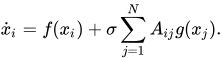
It is assumed that the row sums vanish so that the manifold of synchronous states is neutrally stable.

The master stability function is now defined as the function which maps the complex number to the greatest Lyapunov exponent of the equation


The synchronous state of the system of coupled oscillators is stable if the master stability function is negative at where ranges over the eigenvalues of the coupling matrix .


References
- Arenas, Alex; Díaz-Guilera, Albert; Kurths, Jurgen; Moreno, Yamir; Zhou, Changsong (2008), "Synchronization in complex networks", Physics Reports, 469 (3): 93–153, arXiv:0805.2976, Bibcode:2008PhR...469...93A, doi:10.1016/j.physrep.2008.09.002, S2CID 14355929.
- Pecora, Louis M.; Carroll, Thomas L. (1998), "Master stability functions for synchronized coupled systems", Physical Review Letters, 80 (10): 2109–2112, Bibcode:1998PhRvL..80.2109P, doi:10.1103/PhysRevLett.80.2109.
Content Disclaimer
Informasi ini disarikan dari Wikipedia dan disajikan kembali untuk tujuan edukasi. Konten tersedia di bawah lisensi CC BY-SA 3.0. Kami tidak bertanggung jawab atas ketidakakuratan data yang bersumber dari kontribusi publik tersebut.
- The information displayed on this website is sourced in part or in whole from Wikipedia and has been adapted for the purpose of restating it. We strive to provide accurate and relevant information, however:
- There is no guarantee of absolute accuracy. Wikipedia is an open, collaborative project that can be edited by anyone, so information is subject to change.
- It is not intended to constitute professional advice. The content displayed is for informational and educational purposes only. For important decisions (e.g., medical, legal, or financial), please consult a professional.
- Content copyright. Wikipedia is licensed under the Creative Commons Attribution-ShareAlike License (CC BY-SA). This means that content may be reused with appropriate attribution and shared under a similar license.
- Responsible use. Any risk arising from the use of information from this website is entirely the responsibility of the user.