Using the fact that , the generalized Marcum Q-function can alternatively be defined as a finite integral as
However, it is preferable to have an integral representation of the Marcum Q-function such that (i) the limits of the integral are independent of the arguments of the function, (ii) and that the limits are finite, (iii) and that the integrand is a Gaussian function of these arguments. For positive integer values of , such a representation is given by the trigonometric integral[2][3]
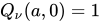
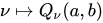
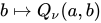
The function is strictly log-concave on for all and , which implies that the generalized Marcum Q-function satisfies the new-is-better-than-used property.[6]
where is the generalized Laguerre polynomial of degree and of order .
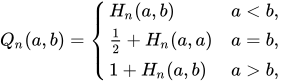
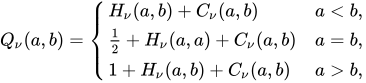
The generalized Marcum Q-function of order can also be represented as Neumann series expansions[4][8]
where the summations are in increments of one. Note that when assumes an integer value, we have .
For non-negative half-integer values , we have a closed form expression for the generalized Marcum Q-function as[8][10]
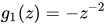
where is the complementary error function. Since Bessel functions with half-integer parameter have finite sum expansions as[4]
where is non-negative integer, we can exactly represent the generalized Marcum Q-function with half-integer parameter. More precisely, we have[4]
for non-negative integers , where is the Gaussian Q-function. Alternatively, we can also more compactly express the Bessel functions with half-integer as sum of hyperbolic sine and cosine functions:[11]
where , , and for any integer value of .
Recurrence relation and generating function
Integrating by parts, we can show that generalized Marcum Q-function satisfies the following recurrence relation[8][10]
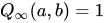
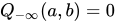
for positive integer . The former recurrence can be used to formally define the generalized Marcum Q-function for negative . Taking and for , we obtain the Neumann series representation of the generalized Marcum Q-function.
Various upper and lower bounds of generalized Marcum-Q function can be obtained using monotonicity and log-concavity of the function and the fact that we have closed form expression for when is half-integer valued.
Let and denote the pair of half-integer rounding operators that map a real to its nearest left and right half-odd integer, respectively, according to the relations
where and denote the integer floor and ceiling functions.
The monotonicity of the function for all and gives us the following simple bound[14][8][15]
However, the relative error of this bound does not tend to zero when .[5] For integral values of , this bound reduces to
A very good approximation of the generalized Marcum Q-function for integer valued is obtained by taking the arithmetic mean of the upper and lower bound[15]
A tighter bound can be obtained by exploiting the log-concavity of on as[5]
where and for . The tightness of this bound improves as either or increases. The relative error of this bound converges to 0 as .[5] For integral values of , this bound reduces to
Cauchy-Schwarz bound
Using the trigonometric integral representation for integer valued , the following Cauchy-Schwarz bound can be obtained[3]
where .
Exponential-type bounds
For analytical purpose, it is often useful to have bounds in simple exponential form, even though they may not be the tightest bounds achievable. Letting , one such bound for integer valued is given as[16][3]
When , the bound simplifies to give
Another such bound obtained via Cauchy-Schwarz inequality is given as[3]
Chernoff-type bound
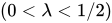
Chernoff-type bounds for the generalized Marcum Q-function, where is an integer, is given by[16][3]
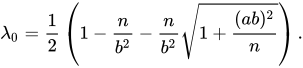
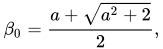
where the Chernoff parameter has optimum value of
Semi-linear approximation
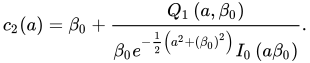
The first-order Marcum-Q function can be semi-linearly approximated by [17]
where
and
Equivalent forms for efficient computation
It is convenient to re-express the Marcum Q-function as[18]
The can be interpreted as the detection probability of incoherently integrated received signal samples of constant received signal-to-noise ratio, , with a normalized detection threshold . In this equivalent form of Marcum Q-function, for given and , we have and . Many expressions exist that can represent . However, the five most reliable, accurate, and efficient ones for numerical computation are given below. They are form one:[18]
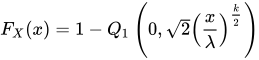
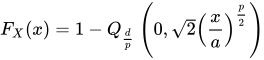
If is a chi distribution with degrees of freedom, then its cdf is given by
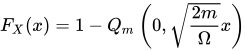
If is a Nakagami distribution with as shape parameter and as spread parameter, then its cdf is given by
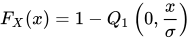
If is a Rice distribution with parameters and , then its cdf is given by
If is a non-central chi distribution with non-centrality parameter and degrees of freedom, then its cdf is given by
Footnotes
^J.I. Marcum (1960). A statistical theory of target detection by pulsed radar: mathematical appendix, IRE Trans. Inform. Theory, vol. 6, 59-267.
^M.K. Simon and M.-S. Alouini (1998). A Unified Approach to the Performance of Digital Communication over Generalized Fading Channels, Proceedings of the IEEE, 86(9), 1860-1877.
^ abcdeA. Annamalai and C. Tellambura (2001). Cauchy-Schwarz bound on the generalized Marcum-Q function with applications, Wireless Communications and Mobile Computing, 1(2), 243-253.
^ abcdA. Annamalai and C. Tellambura (2008). A Simple Exponential Integral Representation of the Generalized Marcum Q-Function QM(a,b) for Real-Order M with Applications. 2008 IEEE Military Communications Conference, San Diego, CA, USA
^ abcdefgY. Sun, A. Baricz, and S. Zhou (2010). On the Monotonicity, Log-Concavity, and Tight Bounds of the Generalized Marcum and Nuttall Q-Functions. IEEE Transactions on Information Theory, 56(3), 1166–1186, ISSN0018-9448
^ abY. Sun and A. Baricz (2008). Inequalities for the generalized Marcum Q-function. Applied Mathematics and Computation 203(2008) 134-141.
^ abcdefN.M. Temme (1993). Asymptotic and numerical aspects of the noncentral chi-square distribution. Computers Math. Applic., 25(5), 55-63.
^ abcdefA. Annamalai, C. Tellambura and John Matyjas (2009). "A New Twist on the Generalized Marcum Q-Function QM(a, b) with Fractional-Order M and its Applications". 2009 6th IEEE Consumer Communications and Networking Conference, 1–5, ISBN978-1-4244-2308-8
^ abS. Andras, A. Baricz, and Y. Sun (2011) The Generalized Marcum Q-function: An Orthogonal Polynomial Approach. Acta Univ. Sapientiae Mathematica, 3(1), 60-76.
^ abcdefgY.A. Brychkov (2012). On some properties of the Marcum Q function. Integral Transforms and Special Functions 23(3), 177-182.
^W.K. Pratt (1968). Partial Differentials of Marcum's Q Function. Proceedings of the IEEE, 56(7), 1220-1221.
^R. Esposito (1968). Comment on Partial Differentials of Marcum's Q Function. Proceedings of the IEEE, 56(12), 2195-2195.
^V.M. Kapinas, S.K. Mihos, G.K. Karagiannidis (2009). On the Monotonicity of the Generalized Marcum and Nuttal Q-Functions. IEEE Transactions on Information Theory, 55(8), 3701-3710.
^ abR. Li, P.Y. Kam, and H. Fu (2010). New Representations and Bounds for the Generalized Marcum Q-Function via a Geometric Approach, and an Application. IEEE Trans. Commun., 58(1), 157-169.
^ abM.K. Simon and M.-S. Alouini (2000). Exponential-Type Bounds on the Generalized Marcum Q-Function with Application to Error Probability Analysis over Fading Channels. IEEE Trans. Commun. 48(3), 359-366.
^H. Guo, B. Makki, M. -S. Alouini and T. Svensson, "A Semi-Linear Approximation of the First-Order Marcum Q-Function With Application to Predictor Antenna Systems," in IEEE Open Journal of the Communications Society, vol. 2, pp. 273-286, 2021, doi: 10.1109/OJCOMS.2021.3056393.
^ abcdefgD.A. Shnidman (1989). The Calculation of the Probability of Detection and the Generalized Marcum Q-Function. IEEE Transactions on Information Theory, 35(2), 389-400.
References
Marcum, J. I. (1950) "Table of Q Functions". U.S. Air Force RAND Research Memorandum M-339. Santa Monica, CA: Rand Corporation, Jan. 1, 1950.
Shnidman, David A. (1989): The Calculation of the Probability of Detection and the Generalized Marcum Q-Function,IEEE Transactions on Information Theory, 35(2), 389–400.
Weisstein, Eric W. Marcum Q-Function. From MathWorld—A Wolfram Web Resource. [1]
Content Disclaimer
Informasi ini disarikan dari Wikipedia dan disajikan kembali untuk tujuan edukasi. Konten tersedia di bawah lisensi CC BY-SA 3.0. Kami tidak bertanggung jawab atas ketidakakuratan data yang bersumber dari kontribusi publik tersebut.
The information displayed on this website is sourced in part or in whole from Wikipedia and has been adapted for the purpose of restating it. We strive to provide accurate and relevant information, however:
There is no guarantee of absolute accuracy. Wikipedia is an open, collaborative project that can be edited by anyone, so information is subject to change.
It is not intended to constitute professional advice. The content displayed is for informational and educational purposes only. For important decisions (e.g., medical, legal, or financial), please consult a professional.
Content copyright. Wikipedia is licensed under the Creative Commons Attribution-ShareAlike License (CC BY-SA). This means that content may be reused with appropriate attribution and shared under a similar license.
Responsible use. Any risk arising from the use of information from this website is entirely the responsibility of the user.










![{\displaystyle C_{\nu }(a,b)={\frac {\sin(\nu \pi )}{\pi }}\exp \left(-{\frac {a^{2}+b^{2}}{2}}\right)\int _{0}^{1}{\frac {(x/\zeta )^{\nu -1}}{\zeta +x}}\exp \left[-{\frac {ab}{2}}\left(x+{\frac {1}{x}}\right)\right]\mathrm {d} x.}](https://wikimedia.org/api/rest_v1/media/math/render/svg/b4bfd0790bab5e68802f462e3ded846e347513c4)


















![{\displaystyle Q_{n+1/2}(a,b)={\frac {1}{2}}\left[\mathrm {erfc} \left({\frac {b-a}{\sqrt {2}}}\right)+\mathrm {erfc} \left({\frac {b+a}{\sqrt {2}}}\right)\right]+e^{-(a^{2}+b^{2})/2}\sum _{k=1}^{n}\left({\frac {b}{a}}\right)^{k-1/2}I_{k-1/2}(ab),}](https://wikimedia.org/api/rest_v1/media/math/render/svg/5a428bae3ef60ce3fd57d471242e060896dcfcdd)

![{\displaystyle I_{\pm (n+0.5)}(z)={\frac {1}{\sqrt {\pi }}}\sum _{k=0}^{n}{\frac {(n+k)!}{k!(n-k)!}}\left[{\frac {(-1)^{k}e^{z}\mp (-1)^{n}e^{-z}}{(2z)^{k+0.5}}}\right],}](https://wikimedia.org/api/rest_v1/media/math/render/svg/5cf71534e8902e7bcdcd2f8aad1371d75acd8ded)

![{\displaystyle Q_{n+1/2}(a,b)=Q(b-a)+Q(b+a)+{\frac {1}{b{\sqrt {2\pi }}}}\sum _{i=1}^{n}\left({\frac {b}{a}}\right)^{i}\sum _{k=0}^{i-1}{\frac {(i+k-1)!}{k!(i-k-1)!}}\left[{\frac {(-1)^{k}e^{-(a-b)^{2}/2}+(-1)^{i}e^{-(a+b)^{2}/2}}{(2ab)^{k}}}\right],}](https://wikimedia.org/api/rest_v1/media/math/render/svg/cb1b5fea182c9323844f545c9f4fecbd6bbd52f0)

![{\displaystyle I_{n+{\frac {1}{2}}}(z)={\sqrt {\frac {2z}{\pi }}}\left[g_{n}(z)\sinh(z)+g_{-n-1}(z)\cosh(z)\right],}](https://wikimedia.org/api/rest_v1/media/math/render/svg/b8203307b336247b9bb82d5a285ae80bf8ae636f)







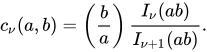





![{\displaystyle Q_{n}(a,b)+Q_{n}(b,a)=1+e^{-(a^{2}+b^{2})/2}\left[I_{0}(ab)+\sum _{k=1}^{n-1}{\frac {a^{2k}+b^{2k}}{(ab)^{k}}}I_{k}(ab)\right].}](https://wikimedia.org/api/rest_v1/media/math/render/svg/111af20e0c19f477e3a8dfa8ac10de16fa86c349)


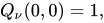
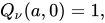

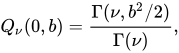

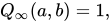

![{\displaystyle Q_{1}(a,a)={\frac {1}{2}}[1+e^{-a^{2}}I_{0}(a^{2})],}](https://wikimedia.org/api/rest_v1/media/math/render/svg/4c38df9d1222ad59bb196d3a78a9c777616ed608)
![{\displaystyle Q_{n}(a,a)={\frac {1}{2}}[1+e^{-a^{2}}I_{0}(a^{2})]+e^{-a^{2}}\sum _{k=1}^{n-1}I_{k}(a^{2}),}](https://wikimedia.org/api/rest_v1/media/math/render/svg/68cc4549662df9a89776595cc88a356f69fd6145)
![{\displaystyle Q_{-n}(a,a)={\frac {1}{2}}[1+e^{-a^{2}}I_{0}(a^{2})]-e^{-a^{2}}\sum _{k=1}^{n}I_{k}(a^{2}),}](https://wikimedia.org/api/rest_v1/media/math/render/svg/b52cda4bd72cf9d005a8b44bfac3f06f8256f8a7)

![{\displaystyle Q_{1/2}(a,b)={\frac {1}{2}}\left[\mathrm {erfc} \left({\frac {b-a}{\sqrt {2}}}\right)+\mathrm {erfc} \left({\frac {b+a}{\sqrt {2}}}\right)\right].}](https://wikimedia.org/api/rest_v1/media/math/render/svg/081dd40ae7e5bad0c354d6665df00fd3b2a849f3)






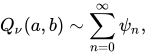

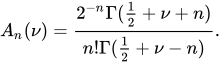
![{\displaystyle \psi _{n}={\frac {1}{2\zeta ^{\nu }{\sqrt {2\pi }}}}(-1)^{n}\left[A_{n}(\nu -1)-\zeta A_{n}(\nu )\right]\phi _{n}.}](https://wikimedia.org/api/rest_v1/media/math/render/svg/50fcfb6150a24e3d1dce191c58b88e7e7002b544)


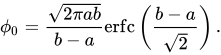
![{\displaystyle \phi _{n}=\left[{\frac {(b-a)^{2}}{2ab}}\right]^{n-{\frac {1}{2}}}\Gamma \left({\frac {1}{2}}-n,{\frac {(b-a)^{2}}{2}}\right),}](https://wikimedia.org/api/rest_v1/media/math/render/svg/21223323ed47dee3268eeea68fd5f93e901aa862)





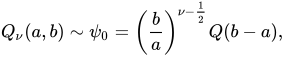
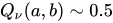




![{\displaystyle {\frac {\partial }{\partial a}}Q_{\nu }(a,b)=a\left[Q_{\nu +1}(a,b)-Q_{\nu }(a,b)\right]=a\left({\frac {b}{a}}\right)^{\nu }e^{-(a^{2}+b^{2})/2}I_{\nu }(ab),}](https://wikimedia.org/api/rest_v1/media/math/render/svg/8f2cc9b22aba8aa7cb19409f5faf43265b66eaf1)
![{\displaystyle {\frac {\partial }{\partial b}}Q_{\nu }(a,b)=b\left[Q_{\nu -1}(a,b)-Q_{\nu }(a,b)\right]=-b\left({\frac {b}{a}}\right)^{\nu -1}e^{-(a^{2}+b^{2})/2}I_{\nu -1}(ab).}](https://wikimedia.org/api/rest_v1/media/math/render/svg/d88cbcc59b5f3befb338fdf1de70b3c2da92d9f1)

![{\displaystyle {\frac {\partial ^{n}}{\partial a^{n}}}Q_{\nu }(a,b)=n!(-a)^{n}\sum _{k=0}^{[n/2]}{\frac {(-2a^{2})^{-k}}{k!(n-2k)!}}\sum _{p=0}^{n-k}(-1)^{p}{\binom {n-k}{p}}Q_{\nu +p}(a,b),}](https://wikimedia.org/api/rest_v1/media/math/render/svg/c5590991b00232c6727b21e105e569505a6dbf1e)
![{\displaystyle {\frac {\partial ^{n}}{\partial b^{n}}}Q_{\nu }(a,b)={\frac {n!a^{1-\nu }}{2^{n}b^{n-\nu +1}}}e^{-(a^{2}+b^{2})/2}\sum _{k=[n/2]}^{n}{\frac {(-2b^{2})^{k}}{(n-k)!(2k-n)!}}\sum _{p=0}^{k-1}{\binom {k-1}{p}}\left(-{\frac {a}{b}}\right)^{p}I_{\nu -p-1}(ab).}](https://wikimedia.org/api/rest_v1/media/math/render/svg/681bd1a41b56319db7186f3d9a222895769d2fb5)















![{\displaystyle e^{-b^{2}/2}\leq Q_{n}(a,b)\leq \exp \left[-{\frac {1}{2}}(b^{2}+a^{2})\right]{\sqrt {I_{0}(2ab)}}{\sqrt {{\frac {2n-1}{2}}+{\frac {\zeta ^{2(1-n)}}{2(1-\zeta ^{2})}}}},\qquad \zeta <1,}](https://wikimedia.org/api/rest_v1/media/math/render/svg/02d46d206be0ca46610cef7174d050284dbc0dbb)
![{\displaystyle 1-Q_{n}(a,b)\leq \exp \left[-{\frac {1}{2}}(b^{2}+a^{2})\right]{\sqrt {I_{0}(2ab)}}{\sqrt {\frac {\zeta ^{2(1-n)}}{2(\zeta ^{2}-1)}}},\qquad \zeta >1,}](https://wikimedia.org/api/rest_v1/media/math/render/svg/11e778e3829a7ee929fb89c5be6366c74d6dbbcd)
![{\displaystyle e^{-(b+a)^{2}/2}\leq Q_{n}(a,b)\leq e^{-(b-a)^{2}/2}+{\frac {\zeta ^{1-n}-1}{\pi (1-\zeta )}}\left[e^{-(b-a)^{2}/2}-e^{-(b+a)^{2}/2}\right],\qquad \zeta <1,}](https://wikimedia.org/api/rest_v1/media/math/render/svg/0a15652302942f992ebaa2f3bb228fbef2e67873)
![{\displaystyle Q_{n}(a,b)\geq 1-{\frac {1}{2}}\left[e^{-(a-b)^{2}/2}-e^{-(a+b)^{2}/2}\right],\qquad \zeta >1.}](https://wikimedia.org/api/rest_v1/media/math/render/svg/8af3a0d51a033c39d5171aef33749366c3f51e9e)

![{\displaystyle 1-{\frac {1}{2}}\left[e^{-(a-b)^{2}/2}-e^{-(a+b)^{2}/2}\right]\leq Q_{1}(a,b),\qquad \zeta >1.}](https://wikimedia.org/api/rest_v1/media/math/render/svg/b64cb05867f6c30fa46843b92e83306b4ad28ba6)
![{\displaystyle e^{-b^{2}/2}\leq Q_{n}(a,b)\leq {\frac {1}{2}}{\sqrt {{\frac {2n-1}{2}}+{\frac {\zeta ^{2(1-n)}}{2(1-\zeta ^{2})}}}}\left[e^{-(b-a)^{2}/2}+e^{-(b+a)^{2}/2}\right],\qquad \zeta <1}](https://wikimedia.org/api/rest_v1/media/math/render/svg/725799b4e54a32be7d4fc5b81998dd881564b41b)
![{\displaystyle Q_{n}(a,b)\geq 1-{\frac {1}{2}}{\sqrt {\frac {\zeta ^{2(1-n)}}{2(\zeta ^{2}-1)}}}\left[e^{-(b-a)^{2}/2}+e^{-(b+a)^{2}/2}\right],\qquad \zeta >1.}](https://wikimedia.org/api/rest_v1/media/math/render/svg/4e5c4439c23548bc0ac3e71f95478389b5cdd35f)