Magic constant
The magic constant or magic sum of a magic square is the sum of numbers in any row, column, or diagonal of the magic square. For example, the magic square shown below has a magic constant of 15. For a normal magic square of order n – that is, a magic square which contains the numbers 1, 2, ..., n2 – the magic constant is .
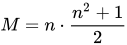

For normal magic squares of orders n = 3, 4, 5, 6, 7, and 8, the magic constants are, respectively: 15, 34, 65, 111, 175, and 260 (sequence A006003 in the OEIS). For example, a normal 8 × 8 square will always equate to 260 for each row, column, or diagonal. The normal magic constant of order n is n3 + n/2. The largest magic constant of normal magic square which is also a:
- triangular number is 15 (solve the Diophantine equation x2 = y3 + 16y + 16, where y is divisible by 4);
- square number is 1 (solve the Diophantine equation x2 = y3 + 4y, where y is even);
- generalized pentagonal number is 171535 (solve the Diophantine equation x2 = y3 + 144y + 144, where y is divisible by 12);
- tetrahedral number is 2925.
Note that 0 and 1 are the only normal magic constants of rational order which are also rational squares.
However, there are infinitely many rational triangular numbers, rational generalized pentagonal numbers and rational tetrahedral numbers which are also magic constants of rational order.
The term magic constant or magic sum is similarly applied to other "magic" figures such as magic stars and magic cubes. Number shapes on a triangular grid divided into equal polyiamond areas containing equal sums give polyiamond magic constant.[1]
Magic stars
The magic constant of an n-pointed normal magic star is .

Magic series
In 2013 Dirk Kinnaes found the magic series polytope. The number of unique sequences that form the magic constant is now known up to .[2]

Moment of inertia
In the mass model, the value in each cell specifies the mass for that cell.[3] This model has two notable properties. First it demonstrates the balanced nature of all magic squares. If such a model is suspended from the central cell the structure balances. (consider the magic sums of the rows/columns .. equal mass at an equal distance balance). The second property that can be calculated is the moment of inertia. Summing the individual moments of inertia (distance squared from the center × the cell value) gives the moment of inertia for the magic square, which depends solely on the order of the square.[4]
See also
References
- ^ "A303295 - Oeis".
- ^ Walter Trump http://www.trump.de/magic-squares/
- ^ Heinz http://www.magic-squares.net/ms-models.htm#A 3 dimensional magic square/
- ^ Peterson http://www.sciencenews.org/view/generic/id/7485/description/Magic_Square_Physics/
External links
| Types | | |
|---|---|---|
| Related shapes | ||
| Higher dimensional shapes | ||
| Classification | ||
| Related concepts | ||
Content Disclaimer
Informasi ini disarikan dari Wikipedia dan disajikan kembali untuk tujuan edukasi. Konten tersedia di bawah lisensi CC BY-SA 3.0. Kami tidak bertanggung jawab atas ketidakakuratan data yang bersumber dari kontribusi publik tersebut.
- The information displayed on this website is sourced in part or in whole from Wikipedia and has been adapted for the purpose of restating it. We strive to provide accurate and relevant information, however:
- There is no guarantee of absolute accuracy. Wikipedia is an open, collaborative project that can be edited by anyone, so information is subject to change.
- It is not intended to constitute professional advice. The content displayed is for informational and educational purposes only. For important decisions (e.g., medical, legal, or financial), please consult a professional.
- Content copyright. Wikipedia is licensed under the Creative Commons Attribution-ShareAlike License (CC BY-SA). This means that content may be reused with appropriate attribution and shared under a similar license.
- Responsible use. Any risk arising from the use of information from this website is entirely the responsibility of the user.