Maekawa's algorithm
Maekawa's algorithm is an algorithm for mutual exclusion on a distributed system. The basis of this algorithm is a quorum-like approach where any one site needs only to seek permissions from a subset of other sites.
Algorithm
Terminology
- A site is any computing device which runs the Maekawa's algorithm
- For any one request of entering the critical section:
- The requesting site is the site which is requesting to enter the critical section.
- The receiving site is every other site which is receiving the request from the requesting site.
- ts refers to the local time stamp of the system according to its logical clock
Algorithm
Requesting site:
- A requesting site sends a message to all sites in its quorum set .

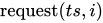

Receiving site:
- Upon reception of a message, the receiving site will:
- If site does not have an outstanding message (that is, a message that has not been released), then site sends a message to site .
- If site has an outstanding message with a process with higher priority than the request, then site sends a message to site and site queues the request from site .
- If site has an outstanding message with a process with lower priority than the request, then site sends an message to the process which has currently been granted access to the critical section by site . (That is, the site with the outstanding message.)
- Upon reception of a message, the site will:
- Send a message to site if and only if site has received a message from some other site or if has sent a yield to some other site but have not received a new .
- Upon reception of a message, site will:
- Send a message to the request on the top of its own request queue. Note that the requests at the top are the highest priority.
- Place into its request queue.
- Upon reception of a message, site will:
- Delete from its request queue.
- Send a message to the request on the top of its request queue.


Critical section:
- Site enters the critical section on receiving a message from all sites in .
- Upon exiting the critical section, sends a message to all sites in .
Quorum set ():
A quorum set must abide by the following properties:

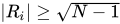
- Site is contained in exactly request sets
![{\displaystyle \forall i\,\forall j\,[R_{i}\bigcap R_{j}\neq \emptyset ]}](https://wikimedia.org/api/rest_v1/media/math/render/svg/f696354afcc2fa3a700b9f331b0f5fe40e55d462)
![{\displaystyle \forall i\,[P_{i}\in R_{i}]}](https://wikimedia.org/api/rest_v1/media/math/render/svg/6321731175473495e8625afeb805349bda62b25c)
![{\displaystyle \forall i\,[|R_{i}|=K]}](https://wikimedia.org/api/rest_v1/media/math/render/svg/994e6e5eb92f9def0d7636260b21184b855abb88)

- Therefore:
Performance
- Number of network messages; to
- Synchronization delay: 2 message propagation delays
- The algorithm can deadlock without protections in place.[1][2]


See also
- Lamport's bakery algorithm
- Lamport's Distributed Mutual Exclusion Algorithm
- Ricart–Agrawala algorithm
- Raymond's algorithm
References
- M. Maekawa, "A √N algorithm for mutual exclusion in decentralized systems”, ACM
Transactions in Computer Systems, vol. 3., no. 2., pp. 145–159, 1985.
- Mamoru Maekawa, Arthur E. Oldehoeft, Rodney R. Oldehoeft (1987). Operating Systems: Advanced Concept. Benjamin/Cummings Publishing Company, Inc.
- B. Sanders (1987). The Information Structure of Distributed Mutual Exclusion Algorithms. ACM Transactions on Computer Systems, Vol. 3, No. 2, pp. 145–59.
Content Disclaimer
Informasi ini disarikan dari Wikipedia dan disajikan kembali untuk tujuan edukasi. Konten tersedia di bawah lisensi CC BY-SA 3.0. Kami tidak bertanggung jawab atas ketidakakuratan data yang bersumber dari kontribusi publik tersebut.
- The information displayed on this website is sourced in part or in whole from Wikipedia and has been adapted for the purpose of restating it. We strive to provide accurate and relevant information, however:
- There is no guarantee of absolute accuracy. Wikipedia is an open, collaborative project that can be edited by anyone, so information is subject to change.
- It is not intended to constitute professional advice. The content displayed is for informational and educational purposes only. For important decisions (e.g., medical, legal, or financial), please consult a professional.
- Content copyright. Wikipedia is licensed under the Creative Commons Attribution-ShareAlike License (CC BY-SA). This means that content may be reused with appropriate attribution and shared under a similar license.
- Responsible use. Any risk arising from the use of information from this website is entirely the responsibility of the user.