Lumpability
In probability theory, lumpability is a method for reducing the size of the state space of some continuous-time Markov chains, first published by Kemeny and Snell.[1]
Definition
Suppose that the complete state-space of a Markov chain is divided into disjoint subsets of states, where these subsets are denoted by ti. This forms a partition of the states. Both the state-space and the collection of subsets may be either finite or countably infinite. A continuous-time Markov chain is lumpable with respect to the partition T if and only if, for any subsets ti and tj in the partition, and for any states n,n’ in subset ti,


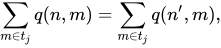
where q(i,j) is the transition rate from state i to state j.[2]
Similarly, for a stochastic matrix P, P is a lumpable matrix on a partition T if and only if, for any subsets ti and tj in the partition, and for any states n,n’ in subset ti,
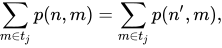
where p(i,j) is the probability of moving from state i to state j.[3]
Example
Consider the matrix
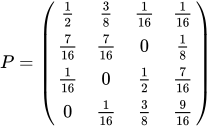
and notice it is lumpable on the partition t = {(1,2),(3,4)} so we write
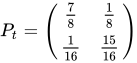
and call Pt the lumped matrix of P on t.
Successively lumpable processes
In 2012, Katehakis and Smit discovered the Successively Lumpable processes for which the stationary probabilities can be obtained by successively computing the stationary probabilities of a propitiously constructed sequence of Markov chains. Each of the latter chains has a (typically much) smaller state space and this yields significant computational improvements. These results have many applications reliability and queueing models and problems.[4]
Quasi–lumpability
Franceschinis and Muntz introduced quasi-lumpability, a property whereby a small change in the rate matrix makes the chain lumpable.[5]
See also
References
- ^ Kemeny, John G.; Snell, J. Laurie (July 1976) [1960]. Gehring, F. W.; Halmos, P. R. (eds.). Finite Markov Chains (Second ed.). New York Berlin Heidelberg Tokyo: Springer-Verlag. p. 124. ISBN 978-0-387-90192-3.
- ^ Jane Hillston, Compositional Markovian Modelling Using A Process Algebra in the Proceedings of the Second International Workshop on Numerical Solution of Markov Chains: Computations with Markov Chains, Raleigh, North Carolina, January 1995. Kluwer Academic Press
- ^ Peter G. Harrison and Naresh M. Patel, Performance Modelling of Communication Networks and Computer Architectures Addison-Wesley 1992
- ^ Katehakis, M. N.; Smit, L. C. (2012). "A Successive Lumping Procedure for a Class of Markov Chains". Probability in the Engineering and Informational Sciences. 26 (4): 483. doi:10.1017/S0269964812000150.
- ^ Franceschinis, G.; Muntz, Richard R. (1993). "Bounds for quasi-lumpable Markov chains". Performance Evaluation. 20 (1–3). Elsevier B.V.: 223–243. doi:10.1016/0166-5316(94)90015-9.
Content Disclaimer
Informasi ini disarikan dari Wikipedia dan disajikan kembali untuk tujuan edukasi. Konten tersedia di bawah lisensi CC BY-SA 3.0. Kami tidak bertanggung jawab atas ketidakakuratan data yang bersumber dari kontribusi publik tersebut.
- The information displayed on this website is sourced in part or in whole from Wikipedia and has been adapted for the purpose of restating it. We strive to provide accurate and relevant information, however:
- There is no guarantee of absolute accuracy. Wikipedia is an open, collaborative project that can be edited by anyone, so information is subject to change.
- It is not intended to constitute professional advice. The content displayed is for informational and educational purposes only. For important decisions (e.g., medical, legal, or financial), please consult a professional.
- Content copyright. Wikipedia is licensed under the Creative Commons Attribution-ShareAlike License (CC BY-SA). This means that content may be reused with appropriate attribution and shared under a similar license.
- Responsible use. Any risk arising from the use of information from this website is entirely the responsibility of the user.