Loop entropy
 | This article has multiple issues. Please help improve it or discuss these issues on the talk page. (Learn how and when to remove these messages)
|


Loop entropy is the entropy lost upon bringing together two residues of a polymer within a prescribed distance. For a single loop, the entropy varies logarithmically with the number of residues in the loop


where is the Boltzmann constant and is a coefficient that depends on the properties of the polymer. This entropy formula corresponds to a power-law distribution for the probability of the residues contacting.


The loop entropy may also vary with the position of the contacting residues. Residues near the ends of the polymer are more likely to contact (quantitatively, have a lower ) than those in the middle (i.e., far from the ends), primarily due to excluded volume effects.
Wang-Uhlenbeck entropy
The loop entropy formula becomes more complicated with multiples loops, but may be determined for a Gaussian polymer using a matrix method developed by Wang and Uhlenbeck. Let there be contacts among the residues, which define loops of the polymers. The Wang-Uhlenbeck matrix is an symmetric, real matrix whose elements equal the number of common residues between loops and . The entropy of making the specified contacts equals



As an example, consider the entropy lost upon making the contacts between residues 26 and 84 and residues 58 and 110 in a polymer (cf. ribonuclease A). The first and second loops have lengths 58 (=84-26) and 52 (=110-58), respectively, and they have 26 (=84-58) residues in common. The corresponding Wang-Uhlenbeck matrix is
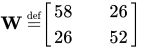
whose determinant is 2340. Taking the logarithm and multiplying by the constants gives the entropy.

References
- Wang, M. C., & Uhlenbeck, G. E. (1945). On the theory of the Brownian motion II. Reviews of Modern Physics, 17(2-3), 323.[1]
 | This thermodynamics-related article is a stub. You can help Wikipedia by adding missing information. |
 | This article about polymer science is a stub. You can help Wikipedia by adding missing information. |
Content Disclaimer
Informasi ini disarikan dari Wikipedia dan disajikan kembali untuk tujuan edukasi. Konten tersedia di bawah lisensi CC BY-SA 3.0. Kami tidak bertanggung jawab atas ketidakakuratan data yang bersumber dari kontribusi publik tersebut.
- The information displayed on this website is sourced in part or in whole from Wikipedia and has been adapted for the purpose of restating it. We strive to provide accurate and relevant information, however:
- There is no guarantee of absolute accuracy. Wikipedia is an open, collaborative project that can be edited by anyone, so information is subject to change.
- It is not intended to constitute professional advice. The content displayed is for informational and educational purposes only. For important decisions (e.g., medical, legal, or financial), please consult a professional.
- Content copyright. Wikipedia is licensed under the Creative Commons Attribution-ShareAlike License (CC BY-SA). This means that content may be reused with appropriate attribution and shared under a similar license.
- Responsible use. Any risk arising from the use of information from this website is entirely the responsibility of the user.