Loewner order
In mathematics, Loewner order is the partial order defined by the convex cone of positive semi-definite matrices. This order is usually employed to generalize the definitions of monotone and concave/convex scalar functions to monotone and concave/convex Hermitian valued functions. These functions arise naturally in matrix and operator theory and have applications in many areas of physics and engineering.
Definition
Let A and B be two Hermitian matrices of order n. We say that A ≥ B if A − B is positive semi-definite. Similarly, we say that A > B if A − B is positive definite.
Although it is commonly discussed on matrices (as a finite-dimensional case), the Loewner order is also well-defined on operators (an infinite-dimensional case) in the analogous way.
Properties
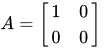
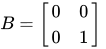
When A and B are real scalars (i.e. n = 1), the Loewner order reduces to the usual ordering of R. Although some familiar properties of the usual order of R are also valid when n ≥ 2, several properties are no longer valid. For instance, the comparability of two matrices may no longer be valid. In fact, if and then neither A ≥ B or B ≥ A holds true. In other words, the Loewner order is a partial order, but not a total order.
Moreover, since A and B are Hermitian matrices, their eigenvalues are all real numbers. If λ1(B) is the maximum eigenvalue of B and λn(A) the minimum eigenvalue of A, a sufficient criterion to have A ≥ B is that λn(A) ≥ λ1(B). If A or B is a multiple of the identity matrix, then this criterion is also necessary.
The Loewner order does not have the least-upper-bound property, and therefore does not form a lattice. It is bounded: for any finite set of matrices, one can find an "upper-bound" matrix A that is greater than all of S. However, there will be multiple upper bounds. In a lattice, there would exist a unique maximum such that any upper bound U on obeys ≤ U. But in the Loewner order, one can have two upper bounds A and B that are both minimal (there is no element C < A that is also an upper bound) but that are incomparable (A - B is neither positive semidefinite nor negative semidefinite).


See also
References
- Pukelsheim, Friedrich (2006). Optimal design of experiments. Society for Industrial and Applied Mathematics. pp. 11–12. ISBN 9780898716047.
- Bhatia, Rajendra (1997). Matrix Analysis. New York, NY: Springer. ISBN 9781461206538.
- Zhan, Xingzhi (2002). Matrix inequalities. Berlin: Springer. pp. 1–15. ISBN 9783540437987.
Content Disclaimer
Informasi ini disarikan dari Wikipedia dan disajikan kembali untuk tujuan edukasi. Konten tersedia di bawah lisensi CC BY-SA 3.0. Kami tidak bertanggung jawab atas ketidakakuratan data yang bersumber dari kontribusi publik tersebut.
- The information displayed on this website is sourced in part or in whole from Wikipedia and has been adapted for the purpose of restating it. We strive to provide accurate and relevant information, however:
- There is no guarantee of absolute accuracy. Wikipedia is an open, collaborative project that can be edited by anyone, so information is subject to change.
- It is not intended to constitute professional advice. The content displayed is for informational and educational purposes only. For important decisions (e.g., medical, legal, or financial), please consult a professional.
- Content copyright. Wikipedia is licensed under the Creative Commons Attribution-ShareAlike License (CC BY-SA). This means that content may be reused with appropriate attribution and shared under a similar license.
- Responsible use. Any risk arising from the use of information from this website is entirely the responsibility of the user.