Lettering guide

A lettering guide template is a special type of template used to write uniform characters. It consists of a sheet of plastic or other material with cut-outs of letters, numbers, and other shapes used especially for creating technical drawings. For decades they have been essential for lettering a drawing nameplate so text and other designs could be made quickly and uniformly.
Although they have been superseded by the use of computers, during the greater part of the last century they were used to relatively ease the lettering process in the creation of technical drawings. They were an indispensable tool for architects and technical illustrators in general, for labeling their drawings and plans but also for the description of projects, in which it was good practice to use a lettering template to achieve uniform and well-written text.
A lettering template could also be used by people illiterate or semi-illiterate to learn to type, or improve their handwriting.[1] In the course of political history some politicians, such as Bettino Craxi, have used them to help people with writing difficulties. They distributed cardboard templates with the sequence of characters of their last name, so they could be easily written during the voting[2] process.
- Lettering guides
-
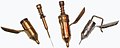 Lettering pens for lettering guide template
 -
 2.5 to 7 millimetres (0.1 to 0.3 in) lettering guides for technical drawings


See also
References
- ^ J. Gray, Kimberly. "How to become a lettering artist". Lettering. Gray. Retrieved 3 July 2017.
- ^ Spini: il normografo è lecito purché il voto resti segreto. La Repubblica. 20 March 1992. p. 10. Retrieved 10 August 2011.
 | This design-related article is a stub. You can help Wikipedia by adding missing information. |
Content Disclaimer
Informasi ini disarikan dari Wikipedia dan disajikan kembali untuk tujuan edukasi. Konten tersedia di bawah lisensi CC BY-SA 3.0. Kami tidak bertanggung jawab atas ketidakakuratan data yang bersumber dari kontribusi publik tersebut.
- The information displayed on this website is sourced in part or in whole from Wikipedia and has been adapted for the purpose of restating it. We strive to provide accurate and relevant information, however:
- There is no guarantee of absolute accuracy. Wikipedia is an open, collaborative project that can be edited by anyone, so information is subject to change.
- It is not intended to constitute professional advice. The content displayed is for informational and educational purposes only. For important decisions (e.g., medical, legal, or financial), please consult a professional.
- Content copyright. Wikipedia is licensed under the Creative Commons Attribution-ShareAlike License (CC BY-SA). This means that content may be reused with appropriate attribution and shared under a similar license.
- Responsible use. Any risk arising from the use of information from this website is entirely the responsibility of the user.