Lesene

A lesene, also called a pilaster strip,[1] is an architectural term for a narrow, low-relief vertical pillar on a wall. It resembles a pilaster, but does not have a base or capital.[2] It is typical in Lombardic and Rijnlandish architectural building styles.[3]
Function
Lesenes are used in architecture to vertically divide a façade or other wall surface optically. However, unlike pilasters, lesenes are simpler, having no bases or capitals. Their function is ornamental, not just to decorate the plain surface of a wall but, in the case of corner lesenes (at the edges of a façade), to emphasise the edges of a building.
Gallery
-
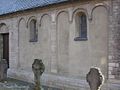 Lesenes and Lombard band (arches) on a chapel
 -
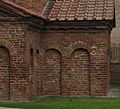 Lesenes forming blind arcades, Mausoleum of Galla Placidia, Ravenna (c. 430); dentils under the eaves.
 -
 Lesene on the staircase tower, Gernrode collegiate church (pre-1000)
 -
 Lesenes on the Maria Laach Abbey (1156)
 -
 Lesenes on the tower of All Saints' Church, Earls Barton (late 10th century)


- Modern and post-modern
-
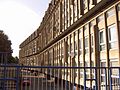 Robin Hood Gardens, London: lesene-shaped formation on the supporting wall in the Plattenbau style
 -
 Lesenes at Chile House, Hamburg
 -
 Lesenes on the Ludgerus Church in Bottrop, North Rhine-Westphalia


References
- ^ Glossary of Medieval Art and Architecture
- ^ Curl, James Stevens (2006). Oxford Dictionary of Architecture and Landscape Architecture, 2nd ed., OUP, Oxford and New York, p. 442. ISBN 978-0-19-860678-9.
- ^ Mulder, Koen (2016). Het Zinderend Oppervlak [The Thrilling Surface] (in Dutch) (2nd ed.). Koen Mulder architect & bouwtechnoloog (published January 2016). p. 157. ISBN 978-90-824668-0-5.

Content Disclaimer
Informasi ini disarikan dari Wikipedia dan disajikan kembali untuk tujuan edukasi. Konten tersedia di bawah lisensi CC BY-SA 3.0. Kami tidak bertanggung jawab atas ketidakakuratan data yang bersumber dari kontribusi publik tersebut.
- The information displayed on this website is sourced in part or in whole from Wikipedia and has been adapted for the purpose of restating it. We strive to provide accurate and relevant information, however:
- There is no guarantee of absolute accuracy. Wikipedia is an open, collaborative project that can be edited by anyone, so information is subject to change.
- It is not intended to constitute professional advice. The content displayed is for informational and educational purposes only. For important decisions (e.g., medical, legal, or financial), please consult a professional.
- Content copyright. Wikipedia is licensed under the Creative Commons Attribution-ShareAlike License (CC BY-SA). This means that content may be reused with appropriate attribution and shared under a similar license.
- Responsible use. Any risk arising from the use of information from this website is entirely the responsibility of the user.