Lebanese Chileans
| Total population | |
|---|---|
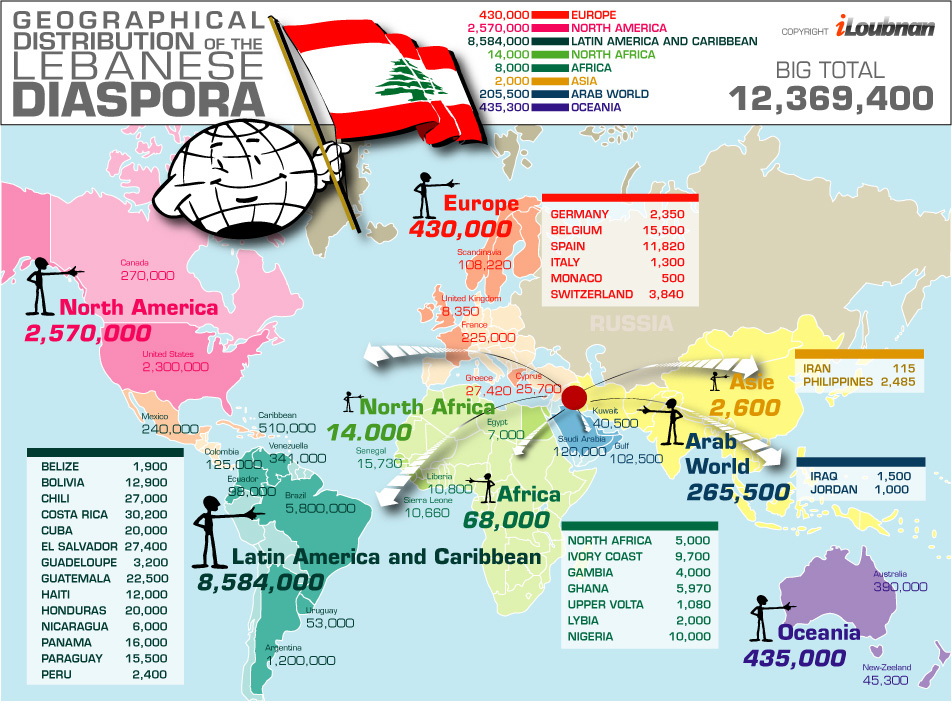
| 27,000 descendants[1] | |
| Regions with significant populations | |
| Valparaíso, La Serena, Santiago | |
| Languages | |
| Chilean Spanish, Lebanese Arabic | |
| Religion | |
| Majority: Eastern Orthodoxy, Roman Catholicism Minority: Judaism, Islam | |
| Related ethnic groups | |
| Arab Chileans, Chilean Jews |
| Part of a series of articles on |
| Lebanese people |
|---|
 |
 Lebanon portal Lebanon portal |
Lebanese Chileans, are immigrants to Chile from Lebanon. Most are Christian and they arrived in Chile in the mid-19th to early-20th centuries to escape from poverty. Ethnically Lebanese Chileans are often called "Turks" (Spanish: Turcos), a term believed to derive from the fact that they arrived from present day Lebanon, which at that time was occupied by the Ottoman Turkish Empire.[2] Most arrived as members of the Eastern Orthodox church and the Maronite church, but became Roman Catholic.[3] Lebanese Jews from Beirut immigrated to Chile in the late 19th century.[4] A minority of Lebanese Muslims are also present in the country.[5]
See also


References
- ^ iLoubnan (2009). "Geographical distribution of Lebanese diaspora". Ya Libnan. Retrieved 17 May 2021.
- ^ Arab and Jewish immigrants in Latin America: images and realities, by Ignacio Klich, Jeff Lesser, 1998, p. 165.
- ^ In Santiago Society, No One Cares If Your Name Is Carey or de Yrarrazaval, By ENID NEMY September 14, 1969, Sunday, Arab and Jewish immigrants in Latin America.
- ^ Frank, Ben G. (2005). A Travel Guide to the Jewish Caribbean and Latin America. Pelican Publishing. p. 405. ISBN 9781455613304. Retrieved 8 April 2026.
- ^ Jaime, Davied (23 November 2015). "EyN: Chilenos ganan espacio dentro de la diversa comunidad islámica de Tarapacá". www.economiaynegocios.cl (in Spanish). Retrieved 28 April 2026.
External links
- Unión General de Estudiantes Palestinos de Chile
- Comerciante palestino en Patronato An article from the Corporación del Patrimonio Cultural de Chile.
| Countries |
| ||||||||||
|---|---|---|---|---|---|---|---|---|---|---|---|
| Personalities |
| ||||||||||
Content Disclaimer
Informasi ini disarikan dari Wikipedia dan disajikan kembali untuk tujuan edukasi. Konten tersedia di bawah lisensi CC BY-SA 3.0. Kami tidak bertanggung jawab atas ketidakakuratan data yang bersumber dari kontribusi publik tersebut.
- The information displayed on this website is sourced in part or in whole from Wikipedia and has been adapted for the purpose of restating it. We strive to provide accurate and relevant information, however:
- There is no guarantee of absolute accuracy. Wikipedia is an open, collaborative project that can be edited by anyone, so information is subject to change.
- It is not intended to constitute professional advice. The content displayed is for informational and educational purposes only. For important decisions (e.g., medical, legal, or financial), please consult a professional.
- Content copyright. Wikipedia is licensed under the Creative Commons Attribution-ShareAlike License (CC BY-SA). This means that content may be reused with appropriate attribution and shared under a similar license.
- Responsible use. Any risk arising from the use of information from this website is entirely the responsibility of the user.