Lavatorium

A lavatorium (plural lavatoria), also anglicised as laver and lavatory, was the communal washing area in a monastery, particularly in medieval abbeys and cathedral cloisters. Monks were required to wash before meals; thus the lavatorium was typically adjacent to the refectory.
Description

All monastic orders required handwashing before meals. A lavatorium was therefore provided near the refectory,[1] either against one wall of the cloister with a long trench basin, or as a free-standing building with a circular or octagonal basin in the centre.[2] An example of the first type, dating to the 14th century, survives at Gloucester Cathedral, and has a towel cupboard nearby. At Durham Cathedral, the lavatorium was a square building with a circular basin which was replaced in 1432–33 with one of marble.[3] At Wenlock Priory, the octagonal lavatorium, now ruined, was decorated with late-12th-century carved panels including one of Jesus with the apostles at the Sea of Galilee.[4][5] There were sometimes taps;[6] at Wenlock Priory, the water spouted from animal heads mounted on the central pillar.[7][8]
Running water was supplied in lead pipes, and where there were taps they were bronze, although in most cases in England metal fittings have been removed since the dissolution of the monasteries.[9] The monks' towels were kept nearby in cupboards called aumbries (derived from the Latin armarium or from Medieval Latin almarium).[10][11] The Refectorian was responsible for keeping the lavatorium clean and ensuring it contained sand and a whetstone for the monks to sharpen their knives, and for changing the towels twice a week.[12]
Gallery
-
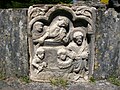 Jesus calling the fishermen; 12th-century carving from the lavatorium at Wenlock Priory, Shropshire
 -
 Arcade in the former lavatorium, Kirkham Priory, North Yorkshire (12th–13th century)
 -
 12th-century lavatorium at the Abbey of St Bavo, Ghent, Belgium
 -
 12th-century lavatorium at Thoronet Abbey in Provence, France
 -
 13th-century lavatorium at Rueda Abbey, Aragon, Spain
 -
 14th-century lavatorium at Maulbronn Monastery, Germany, exterior
 -
 Maulbronn Monastery lavatorium, interior
 -
 Lavatorium at Abbaye aux Dames in Caen, France


See also

References
- ^ "Lavatorium", John William Mollett, An Illustrated Dictionary of Words Used in Art and Archæology: Explaining Terms Frequently Used in Works on Architecture, Arms, Bronzes, Christian Art, Colour, Costume, Decoration, Devices, Emblems, Heraldry, Lace, Personal Ornaments, Pottery, Painting, Sculpture, &c, with their Derivations, London: Sampson Low, Marston, Searle, and Rivington, 1883, OCLC 4423466, p. 191.
- ^ J. Patrick Greene, Medieval Monasteries, Archaeology of medieval Britain, Leicester/New York: Leicester University, 1992, ISBN 9780718512965, repr. Continuum Studies in Medieval History, London: Continuum, 2005, ISBN 9780826478856, pp. 8–9, 116.
- ^ Greene, p. 116.
- ^ Greene, p. 116 and Figure 51, p. 117.
- ^ Lucinda Lambton, Temples of Convenience and Chambers of Delight, New York: St. Martin's, 1995, p. 9, plate p. 31.
- ^ John E. Crowley, The Invention of Comfort: Sensibilities and Design in Early Modern Britain and Early America, Baltimore: Johns Hopkins University, 2001, ISBN 9780801864377, p. 6.
- ^ Lambton, caption p. 30.
- ^ See Frederick Herbert Crossley, The English Abbey: Its Life and Work in the Middle Ages, 1935, repr. Huddersfield: Jeremy Mills, 2007, ISBN 9781905217878, p. 51 for more English abbeys where there are ruins of lavatoria of both types.
- ^ Greene, pp. 115–16.
- ^ Francis Aidan Gasquet, English Monastic Life, The Antiquary's Books, London: Methuen, 1904, OCLC 4014493, p. 19.
- ^ "aumbry", The Catholic Encyclopedia ed. Charles George Herbermann, Edward A. Pace, et al., New York: Encyclopedia Press, 1913, OCLC 1391341, Volume 2 Assize – Brownr, p. 107.
- ^ Gasquet, pp. 78–79.
Content Disclaimer
Informasi ini disarikan dari Wikipedia dan disajikan kembali untuk tujuan edukasi. Konten tersedia di bawah lisensi CC BY-SA 3.0. Kami tidak bertanggung jawab atas ketidakakuratan data yang bersumber dari kontribusi publik tersebut.
- The information displayed on this website is sourced in part or in whole from Wikipedia and has been adapted for the purpose of restating it. We strive to provide accurate and relevant information, however:
- There is no guarantee of absolute accuracy. Wikipedia is an open, collaborative project that can be edited by anyone, so information is subject to change.
- It is not intended to constitute professional advice. The content displayed is for informational and educational purposes only. For important decisions (e.g., medical, legal, or financial), please consult a professional.
- Content copyright. Wikipedia is licensed under the Creative Commons Attribution-ShareAlike License (CC BY-SA). This means that content may be reused with appropriate attribution and shared under a similar license.
- Responsible use. Any risk arising from the use of information from this website is entirely the responsibility of the user.