Landau kernel
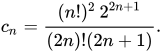
The Landau kernel is named after the German number theorist Edmund Landau. The kernel is a summability kernel defined as:[1]
where the coefficients are defined as follows:


Visualisation
Using integration by parts, one can show that:[2] Hence, this implies that the Landau kernel can be defined as follows:
![{\displaystyle L_{n}(t)={\begin{cases}(1-t^{2})^{n}{\frac {(2n)!(2n+1)}{(n!)^{2}\,2^{2n+1}}}&{\text{for }}t\in [-1,1]\\0&{\text{elsewhere}}\end{cases}}}](https://wikimedia.org/api/rest_v1/media/math/render/svg/385e0861d9e7694e557a6a40ce737b1ac735f1a6)
Plotting this function for different values of n reveals that as n goes to infinity, approaches the Dirac delta function, as seen in the image,[1] where the following functions are plotted.

Properties
Some general properties of the Landau kernel is that it is nonnegative and continuous on . These properties are made more concrete in the following section.

Dirac sequences
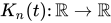
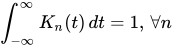
Definition: Dirac sequence—A Dirac sequence is a sequence of functions that satisfies the following properities:



![{\displaystyle {}\quad \int _{\mathbb {R} \smallsetminus [-\delta ,\delta ]}K_{n}(t)\,dt=\int _{-\infty }^{-\delta }K_{n}(t)\,dt+\int _{\delta }^{\infty }K_{n}(t)\,dt<\varepsilon }](https://wikimedia.org/api/rest_v1/media/math/render/svg/4fa2f22c2f0e299da224c8f308e4d951a6ffd9fb)
The third bullet point means that the area under the graph of the function becomes increasingly concentrated close to the origin as n approaches infinity. This definition lends us to the following theorem.

Theorem—The sequence of Landau kernels is a Dirac sequence
Proof: We prove the third property only. In order to do so, we introduce the following lemma:
Lemma—The coefficients satsify the following relationship,

Proof of the Lemma:
Using the definition of the coefficients above, we find that the integrand is even, we may writecompleting the proof of the lemma. A corollary of this lemma is the following:

Corollary—For all positive, real

![{\displaystyle \int _{\mathbb {R} \smallsetminus [-\delta ,\delta ]}K_{n}(t)\,dt\leq {\frac {2}{c_{n}}}\int _{\delta }^{1}(1-t^{2})^{n}\,dt\leq (n+1)(1-\delta ^{2})^{n}}](https://wikimedia.org/api/rest_v1/media/math/render/svg/506576a00313142b6c413139e93f6655d5259434)
See also
References
- ^ a b Terras, Audrey (May 25, 2009). "Lecture 8. Dirac and Weierstrass" (PDF).
- ^ Hilber, Courant. Methods of Mathematical Physics, Vol. I. p. 84.
Content Disclaimer
Informasi ini disarikan dari Wikipedia dan disajikan kembali untuk tujuan edukasi. Konten tersedia di bawah lisensi CC BY-SA 3.0. Kami tidak bertanggung jawab atas ketidakakuratan data yang bersumber dari kontribusi publik tersebut.
- The information displayed on this website is sourced in part or in whole from Wikipedia and has been adapted for the purpose of restating it. We strive to provide accurate and relevant information, however:
- There is no guarantee of absolute accuracy. Wikipedia is an open, collaborative project that can be edited by anyone, so information is subject to change.
- It is not intended to constitute professional advice. The content displayed is for informational and educational purposes only. For important decisions (e.g., medical, legal, or financial), please consult a professional.
- Content copyright. Wikipedia is licensed under the Creative Commons Attribution-ShareAlike License (CC BY-SA). This means that content may be reused with appropriate attribution and shared under a similar license.
- Responsible use. Any risk arising from the use of information from this website is entirely the responsibility of the user.