Lagrange number
In mathematics, the Lagrange numbers (A382098 and A382099 in the OEIS) are a sequence of numbers that appear in bounds relating to the approximation of irrational numbers by rational numbers. They are linked to Hurwitz's theorem.
Definition
Hurwitz improved Peter Gustav Lejeune Dirichlet's criterion on irrationality to the statement that a real number is irrational if and only if there are infinitely many rational numbers , written in simplest terms, such that


- .
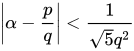
This was an improvement on Dirichlet's result which had on the right-hand side. The above result is best possible, since the golden ratio is irrational. If we replace with any larger number in the above expression, we will only be able to find finitely many rational numbers that satisfy the inequality for .


Hurwitz also showed that if we omit (and numbers derived therefrom), we can increase the to . Again this new bound is best possible, this time with being the problem. If we omit, we can further increase the to . Repeating this process we get the infinite series which converges to 3.[1] These are the Lagrange numbers,[2] named after Joseph Louis Lagrange.[why?]


Relation to Markov numbers
The th Lagrange number is given by[why?]


where is the th Markov number[3]—the th-smallest integer such that the equation


has a solution in positive integers and .


References
- Cassels, J.W.S. (1957). An introduction to Diophantine approximation. Cambridge Tracts in Mathematics and Mathematical Physics. Vol. 45. Cambridge University Press. Zbl 0077.04801.
- Conway, J.H.; Guy, R.K. (1996). The Book of Numbers. New York: Springer-Verlag. ISBN 0-387-97993-X.
External links
- Lagrange number. From MathWorld at Wolfram Research.
- Introduction to Diophantine methods irrationality and transcendence Archived 2012-02-09 at the Wayback Machine - Online lecture notes by Michel Waldschmidt, Lagrange Numbers on pp. 24–26.
Content Disclaimer
Informasi ini disarikan dari Wikipedia dan disajikan kembali untuk tujuan edukasi. Konten tersedia di bawah lisensi CC BY-SA 3.0. Kami tidak bertanggung jawab atas ketidakakuratan data yang bersumber dari kontribusi publik tersebut.
- The information displayed on this website is sourced in part or in whole from Wikipedia and has been adapted for the purpose of restating it. We strive to provide accurate and relevant information, however:
- There is no guarantee of absolute accuracy. Wikipedia is an open, collaborative project that can be edited by anyone, so information is subject to change.
- It is not intended to constitute professional advice. The content displayed is for informational and educational purposes only. For important decisions (e.g., medical, legal, or financial), please consult a professional.
- Content copyright. Wikipedia is licensed under the Creative Commons Attribution-ShareAlike License (CC BY-SA). This means that content may be reused with appropriate attribution and shared under a similar license.
- Responsible use. Any risk arising from the use of information from this website is entirely the responsibility of the user.