Kautz graph

The Kautz graph is a directed graph of degree and dimension , which has vertices labeled by all possible strings of length which are composed of characters chosen from an alphabet containing distinct symbols, subject to the condition that adjacent characters in the string cannot be equal ().


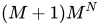


The Kautz graph has edges
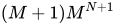

It is natural to label each such edge of as , giving a one-to-one correspondence between edges of the Kautz graph and vertices of the Kautz graph .


Kautz graphs are closely related to De Bruijn graphs.
Properties
- For a fixed degree and number of vertices , the Kautz graph has the smallest diameter of any possible directed graph with vertices and degree .
- All Kautz graphs have Eulerian cycles. (An Eulerian cycle is one which visits each edge exactly once—This result follows because Kautz graphs have in-degree equal to out-degree for each node)
- All Kautz graphs have a Hamiltonian cycle (This result follows from the correspondence described above between edges of the Kautz graph and vertices of the Kautz graph ; a Hamiltonian cycle on is given by an Eulerian cycle on )
- A degree- Kautz graph has disjoint paths from any node to any other node .


In computing
The Kautz graph has been used as a network topology for connecting processors in high-performance computing and fault-tolerant computing[1] applications: such a network is known as a Kautz network.
Notes
- ^ Li, Dongsheng; Xicheng Lu; Jinshu Su (2004). "Graph-Theoretic Analysis of Kautz Topology and DHT Schemes". Network and Parallel Computing: IFIP International Conference. Wuhan, China: NPC. pp. 308–315. ISBN 3-540-23388-1. Retrieved 2008-03-05.
This article incorporates material from Kautz graph on PlanetMath, which is licensed under the Creative Commons Attribution/Share-Alike License.
Content Disclaimer
Informasi ini disarikan dari Wikipedia dan disajikan kembali untuk tujuan edukasi. Konten tersedia di bawah lisensi CC BY-SA 3.0. Kami tidak bertanggung jawab atas ketidakakuratan data yang bersumber dari kontribusi publik tersebut.
- The information displayed on this website is sourced in part or in whole from Wikipedia and has been adapted for the purpose of restating it. We strive to provide accurate and relevant information, however:
- There is no guarantee of absolute accuracy. Wikipedia is an open, collaborative project that can be edited by anyone, so information is subject to change.
- It is not intended to constitute professional advice. The content displayed is for informational and educational purposes only. For important decisions (e.g., medical, legal, or financial), please consult a professional.
- Content copyright. Wikipedia is licensed under the Creative Commons Attribution-ShareAlike License (CC BY-SA). This means that content may be reused with appropriate attribution and shared under a similar license.
- Responsible use. Any risk arising from the use of information from this website is entirely the responsibility of the user.