Kato theorem
The Kato theorem, or Kato's cusp condition (after Japanese mathematician Tosio Kato), is used in computational quantum physics.[1][2] It states that for generalized Coulomb potentials, the electron density has a cusp at the position of the nuclei, where it satisfies
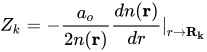
Here denotes the positions of the nuclei, their atomic number and is the Bohr radius.


For a Coulombic system one can thus, in principle, read off all information necessary for completely specifying the Hamiltonian directly from examining the density distribution. This is also known as E. Bright Wilson's argument within the framework of density functional theory (DFT). The electron density of the ground state of a molecular system contains cusps at the location of the nuclei, and by identifying these from the total electron density of the system, the positions are thus established. From Kato's theorem, one also obtains the nuclear charge of the nuclei, and thus the external potential is fully defined. Finally, integrating the electron density over space gives the number of electrons, and the (electronic) Hamiltonian is defined. This is valid in a non-relativistic treatment within the Born–Oppenheimer approximation, and assuming point-like nuclei.
References
- ^ Kato, Tosio (1957). "On the eigenfunctions of many-particle systems in quantum mechanics". Communications on Pure and Applied Mathematics. 10 (2): 151–177. doi:10.1002/cpa.3160100201.
- ^ March, N. H. (1986). "Spatially dependent generalization of Kato's theorem for atomic closed shells in a bare Coulomb field". Phys. Rev. A. 33 (1): 88–89. Bibcode:1986PhRvA..33...88M. doi:10.1103/PhysRevA.33.88. PMID 9896587.
 | This quantum mechanics–related article is a stub. You can help Wikipedia by adding missing information. |
Content Disclaimer
Informasi ini disarikan dari Wikipedia dan disajikan kembali untuk tujuan edukasi. Konten tersedia di bawah lisensi CC BY-SA 3.0. Kami tidak bertanggung jawab atas ketidakakuratan data yang bersumber dari kontribusi publik tersebut.
- The information displayed on this website is sourced in part or in whole from Wikipedia and has been adapted for the purpose of restating it. We strive to provide accurate and relevant information, however:
- There is no guarantee of absolute accuracy. Wikipedia is an open, collaborative project that can be edited by anyone, so information is subject to change.
- It is not intended to constitute professional advice. The content displayed is for informational and educational purposes only. For important decisions (e.g., medical, legal, or financial), please consult a professional.
- Content copyright. Wikipedia is licensed under the Creative Commons Attribution-ShareAlike License (CC BY-SA). This means that content may be reused with appropriate attribution and shared under a similar license.
- Responsible use. Any risk arising from the use of information from this website is entirely the responsibility of the user.