Kappōgi
.jpg)
| External image | |
|---|---|
 Kappōgi worn over kimono Kappōgi worn over kimono |
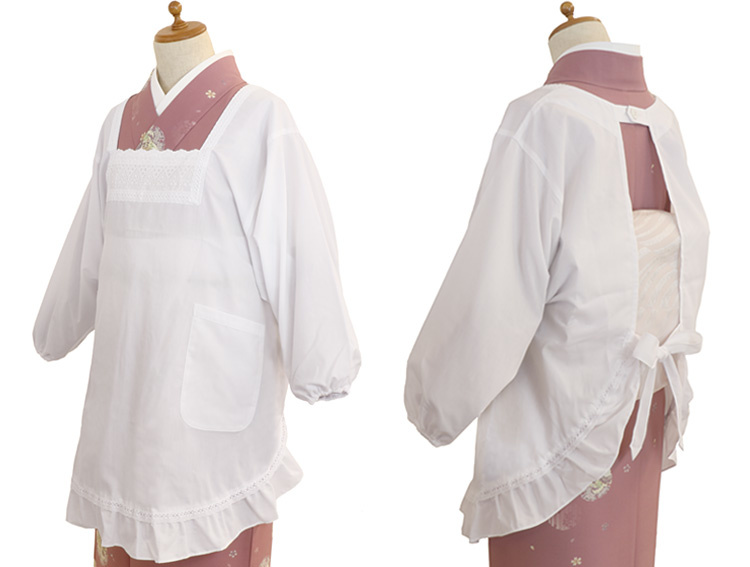

A kappōgi (割烹着, "cooking wear") is a type of smock, originating in Japan. First designed to protect kimono from stains when cooking, it has baggy sleeves with gathered cuffs terminating just after the elbow, and the torso comes down to the wearer's knees.[1] It closes by means of strips of cloth that are tied at the back of the neck and waist. It is particularly used when cooking and cleaning.
The kappōgi was introduced at Japan's first culinary academy, Akahori Kappō School, in 1902, when most people wore kimono on a daily basis.[2][1]
References
- ^ a b Klippensteen, Kate (2006). COOL TOOLS: Cooking Utensils from the Japanese Kitchen. Kodansha International. p. 27. ISBN 4770030169.
kappogi.
- ^ 赤堀料理学園のあゆみ [History of the Akahori Cooking School] (in Japanese). Akahori Cooking School. Archived from the original on 2019-07-16. Retrieved 2019-07-16.
External links
- Image of kappōgi over kimono (front view)
- Image of kappōgi over kimono (back view)


 | This article related to the culture of Japan is a stub. You can help Wikipedia by adding missing information. |
 | This clothing-related article is a stub. You can help Wikipedia by adding missing information. |
Content Disclaimer
Informasi ini disarikan dari Wikipedia dan disajikan kembali untuk tujuan edukasi. Konten tersedia di bawah lisensi CC BY-SA 3.0. Kami tidak bertanggung jawab atas ketidakakuratan data yang bersumber dari kontribusi publik tersebut.
- The information displayed on this website is sourced in part or in whole from Wikipedia and has been adapted for the purpose of restating it. We strive to provide accurate and relevant information, however:
- There is no guarantee of absolute accuracy. Wikipedia is an open, collaborative project that can be edited by anyone, so information is subject to change.
- It is not intended to constitute professional advice. The content displayed is for informational and educational purposes only. For important decisions (e.g., medical, legal, or financial), please consult a professional.
- Content copyright. Wikipedia is licensed under the Creative Commons Attribution-ShareAlike License (CC BY-SA). This means that content may be reused with appropriate attribution and shared under a similar license.
- Responsible use. Any risk arising from the use of information from this website is entirely the responsibility of the user.