Jost function
 | This article has multiple issues. Please help improve it or discuss these issues on the talk page. (Learn how and when to remove these messages)
|

In scattering theory, the Jost function is the Wronskian of the regular solution and the (irregular) Jost solution to the differential equation .

It was introduced by Res Jost.
Background
We are looking for solutions to the radial Schrödinger equation in the case ,



Regular and irregular solutions
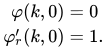
A regular solution is one that satisfies the boundary conditions,

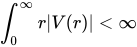
If , the solution is given as a Volterra integral equation,

There are two irregular solutions (sometimes called Jost solutions) with asymptotic behavior as . They are given by the Volterra integral equation,




If , then are linearly independent. Since they are solutions to a second order differential equation, every solution (in particular ) can be written as a linear combination of them.


Jost function definition
The Jost function is
,

where W is the Wronskian. Since are both solutions to the same differential equation, the Wronskian is independent of r. So evaluating at and using the boundary conditions on yields .



Applications
The Jost function can be used to construct Green's functions for
![{\displaystyle \left[-{\frac {\partial ^{2}}{\partial r^{2}}}+V(r)-k^{2}\right]G=-\delta (r-r').}](https://wikimedia.org/api/rest_v1/media/math/render/svg/2e070d5f1eada1f2d25a08538ef33a05c76a6593)
In fact,

where and .


The analyticity of the Jost function in the particle momentum allows to establish a relationship between the scattering phase difference with infinite and zero momenta on one hand and the number of bound states , the number of Jaffe - Low primitives , and the number of Castillejo - Daliz - Dyson poles on the other (Levinson's theorem):


- .

Here is the scattering phase and = 0 or 1. The value corresponds to the exceptional case of a -wave scattering in the presence of a bound state with zero energy.


References
- Newton, Roger G. (1966). Scattering Theory of Waves and Particles. New York: McGraw-Hill. Bibcode:1966stwp.book.....N. OCLC 362294.
- Yafaev, D. R. (1992). Mathematical Scattering Theory. Providence: American Mathematical Society. ISBN 0-8218-4558-6.
 | This scattering–related article is a stub. You can help Wikipedia by adding missing information. |
Content Disclaimer
Informasi ini disarikan dari Wikipedia dan disajikan kembali untuk tujuan edukasi. Konten tersedia di bawah lisensi CC BY-SA 3.0. Kami tidak bertanggung jawab atas ketidakakuratan data yang bersumber dari kontribusi publik tersebut.
- The information displayed on this website is sourced in part or in whole from Wikipedia and has been adapted for the purpose of restating it. We strive to provide accurate and relevant information, however:
- There is no guarantee of absolute accuracy. Wikipedia is an open, collaborative project that can be edited by anyone, so information is subject to change.
- It is not intended to constitute professional advice. The content displayed is for informational and educational purposes only. For important decisions (e.g., medical, legal, or financial), please consult a professional.
- Content copyright. Wikipedia is licensed under the Creative Commons Attribution-ShareAlike License (CC BY-SA). This means that content may be reused with appropriate attribution and shared under a similar license.
- Responsible use. Any risk arising from the use of information from this website is entirely the responsibility of the user.