Jacobi bound problem
 | This article relies largely or entirely on a single source. (December 2022) |
The Jacobi bound problem concerns the veracity of Jacobi's inequality which is an inequality on the absolute dimension of a differential algebraic variety in terms of its defining equations. This is one of Kolchin's Problems.
The inequality is the differential algebraic analog of Bézout's theorem in affine space. Although first formulated by Jacobi, In 1936 Joseph Ritt recognized the problem as non-rigorous in that Jacobi didn't even have a rigorous notion of absolute dimension (Jacobi and Ritt used the term "order" - which Ritt first gave a rigorous definition for using the notion of transcendence degree). Intuitively, the absolute dimension is the number of constants of integration required to specify a solution of a system of ordinary differential equations. A mathematical proof of the inequality has been open since 1936.
Statement
Let be a differential field of characteristic zero and consider a differential algebraic variety determined by the vanishing of differential polynomials . If is an irreducible component of of finite absolute dimension then



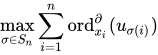
In the above display is the *jacobi number*. It is defined to be

.
References
- Ritt, Joseph F. (1938). "Algebraic aspects of the theory of differential equations" (PDF). Semicentennial Addresses of the American Mathematical Society. Vol. 2. AMS. pp. 35–55. ISBN 0-8218-0119-8.
{{cite book}}: ISBN / Date incompatibility (help) - Lando, Barbara A. (1970). "Jacobi's bound for the order of systems of first order differential equations". Transactions of the American Mathematical Society. 152: 119–135. doi:10.1090/S0002-9947-1970-0279079-1.
- Ollivier, François (2022). "Jacobi's Bound: Jacobi's results translated in Kőnig's, Egerváry's and Ritt's mathematical languages". Applicable Algebra in Engineering, Communication and Computing. 34 (5): 793–885. arXiv:2109.03620. doi:10.1007/s00200-022-00547-6. S2CID 237440393.
Content Disclaimer
Informasi ini disarikan dari Wikipedia dan disajikan kembali untuk tujuan edukasi. Konten tersedia di bawah lisensi CC BY-SA 3.0. Kami tidak bertanggung jawab atas ketidakakuratan data yang bersumber dari kontribusi publik tersebut.
- The information displayed on this website is sourced in part or in whole from Wikipedia and has been adapted for the purpose of restating it. We strive to provide accurate and relevant information, however:
- There is no guarantee of absolute accuracy. Wikipedia is an open, collaborative project that can be edited by anyone, so information is subject to change.
- It is not intended to constitute professional advice. The content displayed is for informational and educational purposes only. For important decisions (e.g., medical, legal, or financial), please consult a professional.
- Content copyright. Wikipedia is licensed under the Creative Commons Attribution-ShareAlike License (CC BY-SA). This means that content may be reused with appropriate attribution and shared under a similar license.
- Responsible use. Any risk arising from the use of information from this website is entirely the responsibility of the user.