Isoionic point
The isoionic point is the pH value at which a zwitterion molecule has an equal number of positive and negative charges and no adherent ionic species. It was first defined by S.P.L. Sørensen, Kaj Ulrik Linderstrøm-Lang and Ellen Lund in 1926 [1] and is mainly a term used in protein sciences.
It is different from the isoelectric point (pI) in that pI is the pH value at which the net charge of the molecule, including bound ions is zero. Whereas the isoionic point is at net charge zero in a deionized solution. Thus, the isoelectric and isoionic points are equal when the concentration of charged species is zero.
For a diprotic acid, the hydrogen ion concentration can be found at the isoionic point using the following equation[2]
![{\displaystyle [H^{+}]={\sqrt {{K_{1}K_{2}C+K_{1}K_{w}} \over {K_{1}+C}}}}](https://wikimedia.org/api/rest_v1/media/math/render/svg/d28f22243550da9b6bcb46ecaa50e26625aa5acd)
- = hydrogen ion concentration
- = first acid dissociation constant
- = second acid dissociation constant
- = dissociation constant for water
- = concentration of the acid
![{\displaystyle [H^{+}]}](https://wikimedia.org/api/rest_v1/media/math/render/svg/92a39e055b2aeeb66152908dc9af7b721759d53e)


Note that if then and if then . Therefore, under these conditions, the equation simplifies to



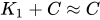
![{\displaystyle [H^{+}]={\sqrt {{K_{1}K_{2}C+K_{1}K_{w}} \over {K_{1}+C}}}\approx {\sqrt {{K_{1}K_{2}C} \over {C}}}\approx {\sqrt {K_{1}K_{2}}}}](https://wikimedia.org/api/rest_v1/media/math/render/svg/7dc27828259861700c40b82a35514a17dfe1e079)
The equation can be further simplified to calculate the pH by taking the negative logarithm of both sides to yield
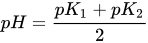
which shows that under certain conditions, the isoionic and isoelectric point are similar.
References
- ^ Sørensen S.P.L., Linderstrøm-Lang K., and Lund E (1926). 'The influence of salt concentration on the acid-binding capacity of egg-albumin'. J. Gen. Physiol., Mar 1927; 8: 543 - 599
- ^ Bryan, William P. (1978). "The isoionic point of amino acids and proteins". Biochemical Education. 6: 14–15. doi:10.1016/0307-4412(78)90164-4.
Content Disclaimer
Informasi ini disarikan dari Wikipedia dan disajikan kembali untuk tujuan edukasi. Konten tersedia di bawah lisensi CC BY-SA 3.0. Kami tidak bertanggung jawab atas ketidakakuratan data yang bersumber dari kontribusi publik tersebut.
- The information displayed on this website is sourced in part or in whole from Wikipedia and has been adapted for the purpose of restating it. We strive to provide accurate and relevant information, however:
- There is no guarantee of absolute accuracy. Wikipedia is an open, collaborative project that can be edited by anyone, so information is subject to change.
- It is not intended to constitute professional advice. The content displayed is for informational and educational purposes only. For important decisions (e.g., medical, legal, or financial), please consult a professional.
- Content copyright. Wikipedia is licensed under the Creative Commons Attribution-ShareAlike License (CC BY-SA). This means that content may be reused with appropriate attribution and shared under a similar license.
- Responsible use. Any risk arising from the use of information from this website is entirely the responsibility of the user.