Isoelastic function
In mathematical economics, an isoelastic function, sometimes constant elasticity function, is a function that exhibits a constant elasticity, i.e. has a constant elasticity coefficient. The elasticity is the ratio of the percentage change in the dependent variable to the percentage causative change in the independent variable, in the limit as the changes approach zero in magnitude.
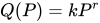
For an elasticity coefficient (which can take on any real value), the function's general form is given by


where and are constants. The elasticity is by definition


which for this function simply equals r.
Derivation
Elasticity of demand is indicated by
,

where r is the elasticity, Q is quantity, and P is price.
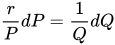
Rearranging gets us:
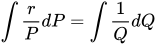
Then integrating

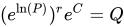
Simplify


Examples
Demand functions
An example in microeconomics is the constant elasticity demand function, in which p is the price of a product and D(p) is the resulting quantity demanded by consumers. For most goods the elasticity r (the responsiveness of quantity demanded to price) is negative, so it can be convenient to write the constant elasticity demand function with a negative sign on the exponent, in order for the coefficient to take on a positive value:
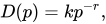
where is now interpreted as the unsigned magnitude of the responsiveness.[1] An analogous function exists for the supply curve.

Utility functions in the presence of risk
The constant elasticity function is also used in the theory of choice under risk aversion, which usually assumes that risk-averse decision-makers maximize the expected value of a concave von Neumann-Morgenstern utility function. In this context, with a constant elasticity of utility with respect to, say, wealth, optimal decisions on such things as shares of stocks in a portfolio are independent of the scale of the decision-maker's wealth. The constant elasticity utility function in this context is generally written as
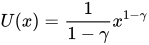
where x is wealth and is the elasticity, with , ≠ 1 referred to as the constant coefficient of relative risk aversion (with risk aversion approaching infinity as → ∞).


See also
References
- ^ Simon, Carl P.; Blume, Lawrence (1994). Mathematics for Economists. New York: Norton. p. 67. ISBN 0393957330.
External links
Content Disclaimer
Informasi ini disarikan dari Wikipedia dan disajikan kembali untuk tujuan edukasi. Konten tersedia di bawah lisensi CC BY-SA 3.0. Kami tidak bertanggung jawab atas ketidakakuratan data yang bersumber dari kontribusi publik tersebut.
- The information displayed on this website is sourced in part or in whole from Wikipedia and has been adapted for the purpose of restating it. We strive to provide accurate and relevant information, however:
- There is no guarantee of absolute accuracy. Wikipedia is an open, collaborative project that can be edited by anyone, so information is subject to change.
- It is not intended to constitute professional advice. The content displayed is for informational and educational purposes only. For important decisions (e.g., medical, legal, or financial), please consult a professional.
- Content copyright. Wikipedia is licensed under the Creative Commons Attribution-ShareAlike License (CC BY-SA). This means that content may be reused with appropriate attribution and shared under a similar license.
- Responsible use. Any risk arising from the use of information from this website is entirely the responsibility of the user.