Inverse square potential
In quantum mechanics, the inverse square potential is a form of a central force potential which has the unusual property of the eigenstates of the corresponding Hamiltonian operator remaining eigenstates in a scaling of all cartesian coordinates by the same constant.[1] Apart from this curious feature, it's by far less important central force problem than that of the Keplerian inverse square force system.
Description
The potential energy function of an inverse square potential is
,
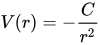
where is some constant and is the Euclidean distance from some central point. If is positive, the potential is attractive and if is negative, the potential is repulsive. The corresponding Hamiltonian operator is


,
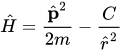
where is the mass of the particle moving in the potential.

Properties
The canonical commutation relation of quantum mechanics, , has the property of being invariant in a scaling
![{\displaystyle [{\hat {x}}_{i},{\hat {p}}_{i}]=i\hbar }](https://wikimedia.org/api/rest_v1/media/math/render/svg/29332d10932741647cfa29dc4a06bd5594f2a0f8)
, and ,


where is some scaling factor. The momentum and the position are vectors, while the components , and the radius are scalars. In an inverse square potential system, if a wavefunction is an eigenfunction of the Hamiltonian operator , it is also an eigenfunction of the operator , where the scaled operators and are defined as above.


This also means that if a radially symmetric wave function is an eigenfunction of with eigenvalue , then also is an eigenfunction, with eigenvalue . Therefore, the energy spectrum of the system is a continuum of values.


The system with a particle in an inverse square potential with positive (attractive potential) is an example of so-called falling-to-center problem, where there is no lowest energy wavefunction and there are eigenfunctions where the particle is arbitrarily localized in the vicinity of the central point .[2]

See also
References
- ^ Martínez-y-Romero, R. P.; Núñez-Yépez, H. N.; Salas-Brito, A. L. (2013). "The two dimensional motion of a particle in an inverse square potential: Classical and quantum aspects" (PDF). Journal of Mathematical Physics. 54 (5): 053509. doi:10.1063/1.4804356. ISSN 0022-2488. Archived from the original (PDF) on 2019-02-04. Retrieved 2017-06-11.
- ^ Vasyuta, Vasyl M.; Tkachuk, Volodymyr M. (2016). "Falling of a quantum particle in an inverse square attractive potential". The European Physical Journal D. 70 (12). arXiv:1505.04750. doi:10.1140/epjd/e2016-70463-3. ISSN 1434-6060. S2CID 118371904.
Content Disclaimer
Informasi ini disarikan dari Wikipedia dan disajikan kembali untuk tujuan edukasi. Konten tersedia di bawah lisensi CC BY-SA 3.0. Kami tidak bertanggung jawab atas ketidakakuratan data yang bersumber dari kontribusi publik tersebut.
- The information displayed on this website is sourced in part or in whole from Wikipedia and has been adapted for the purpose of restating it. We strive to provide accurate and relevant information, however:
- There is no guarantee of absolute accuracy. Wikipedia is an open, collaborative project that can be edited by anyone, so information is subject to change.
- It is not intended to constitute professional advice. The content displayed is for informational and educational purposes only. For important decisions (e.g., medical, legal, or financial), please consult a professional.
- Content copyright. Wikipedia is licensed under the Creative Commons Attribution-ShareAlike License (CC BY-SA). This means that content may be reused with appropriate attribution and shared under a similar license.
- Responsible use. Any risk arising from the use of information from this website is entirely the responsibility of the user.