Inside–outside algorithm
For parsing algorithms in computer science, the inside–outside algorithm is a way of re-estimating production probabilities in a probabilistic context-free grammar. It was introduced by James K. Baker in 1979 as a generalization of the forward–backward algorithm for parameter estimation on hidden Markov models to stochastic context-free grammars. It is used to compute expectations, for example as part of the expectation–maximization algorithm (an unsupervised learning algorithm).
Inside and outside probabilities
The inside probability is the total probability of generating words , given the root nonterminal and a grammar :[1]



The outside probability is the total probability of beginning with the start symbol and generating the nonterminal and all the words outside , given a grammar :[1]



Computing inside probabilities
Base Case:

General case:
Suppose there is a rule in the grammar, then the probability of generating starting with a subtree rooted at is:



The inside probability is just the sum over all such possible rules:

Computing outside probabilities
Base Case:
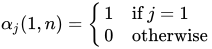
Here the start symbol is .

General case:
Suppose there is a rule in the grammar that generates . Then the left contribution of that rule to the outside probability is:


Now suppose there is a rule in the grammar. Then the right contribution of that rule to the outside probability is:


The outside probability is the sum of the left and right contributions over all such rules:

References
- ^ a b Manning, Christopher D.; Hinrich Schütze (1999). Foundations of Statistical Natural Language Processing. Cambridge, MA, USA: MIT Press. pp. 388–402. ISBN 0-262-13360-1.
- J. Baker (1979): Trainable grammars for speech recognition. In J. J. Wolf and D. H. Klatt, editors, Speech communication papers presented at the 97th meeting of the Acoustical Society of America, pages 547–550, Cambridge, MA, June 1979. MIT.
- Karim Lari, Steve J. Young (1990): The estimation of stochastic context-free grammars using the inside–outside algorithm. Computer Speech and Language, 4:35–56.
- Karim Lari, Steve J. Young (1991): Applications of stochastic context-free grammars using the Inside–Outside algorithm. Computer Speech and Language, 5:237–257.
- Fernando Pereira, Yves Schabes (1992): Inside–outside reestimation from partially bracketed corpora. Proceedings of the 30th annual meeting on Association for Computational Linguistics, Association for Computational Linguistics, 128–135.
External links
Content Disclaimer
Informasi ini disarikan dari Wikipedia dan disajikan kembali untuk tujuan edukasi. Konten tersedia di bawah lisensi CC BY-SA 3.0. Kami tidak bertanggung jawab atas ketidakakuratan data yang bersumber dari kontribusi publik tersebut.
- The information displayed on this website is sourced in part or in whole from Wikipedia and has been adapted for the purpose of restating it. We strive to provide accurate and relevant information, however:
- There is no guarantee of absolute accuracy. Wikipedia is an open, collaborative project that can be edited by anyone, so information is subject to change.
- It is not intended to constitute professional advice. The content displayed is for informational and educational purposes only. For important decisions (e.g., medical, legal, or financial), please consult a professional.
- Content copyright. Wikipedia is licensed under the Creative Commons Attribution-ShareAlike License (CC BY-SA). This means that content may be reused with appropriate attribution and shared under a similar license.
- Responsible use. Any risk arising from the use of information from this website is entirely the responsibility of the user.