Igel Column
| UNESCO World Heritage Site | |
|---|---|
 | |
 Interactive map of Igel Column | |
| Location | Igel, Trier, Rhineland-Palatinate, Germany |
| Part of | Roman Monuments, Cathedral of St Peter and Church of Our Lady in Trier |
| Criteria | Cultural: (i), (iii), (iv), (vi) |
| Reference | 367-004 |
| Inscription | 1986 (10th Session) |
| Coordinates | 49°42′33″N 6°32′58″E / 49.7092°N 6.5494°E |
  Igel Column Location of Igel Column in Germany  Igel Column Igel Column (Rhineland-Palatinate) | |
The Igel Column (German: Igeler Säule) is a multi-storeyed Roman sandstone column in the municipality of Igel, Trier, Germany, dated to c. 250 AD. The column is the burial monument of the Secundinii cloth merchant family, and was built by two of the family members, Lucius Secundinius Aventinus and Lucius Secundinus Securus.[1][2]
Measuring 23 metres (75 ft) in height, it is crowned by the sculptural group of Jupiter and Ganymede.[3] The column includes a four-stepped base, a relatively low podium, topped by a projecting cornice, a storey, its flat Corinthian pilasters with decorated shafts, supporting an architrave, a sculptured frieze and a heavy cornice. The bas-reliefs feature a procession of six coloni, bringing various donations to the house of their master.[4] The coloni are received before the entrance to the atrium.[4] The donations consist of a hare, two fish, a kid, an eel, a rooster and a basket of fruit.[4] The column is made out of red and red-grey sandstone but was originally painted.[2]
Because of its testimony to the importance of Trier during Roman times, the Igel Column was designated as part of the UNESCO World Heritage Site Roman Monuments, Cathedral of St. Peter and Church of Our Lady in Trier in 1986. It has been represented numerous times in paintings and drawings. A polychromed replica dominates the central courtyard of the Rheinisches Landesmuseum Trier.
-
 Joan Blaeu, 1649
 -
 Richard Pococke, 1745
 -
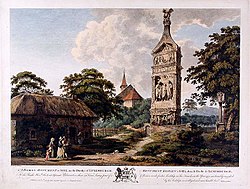 Engraving by William Pars, 1783
 -

-
 Back of the column
 -
 Central relief
 -
 Detail top
 -
 Polychromed replica in the Rheinisches Landesmuseum Trier


.JPG)


References
- ^ "Igel Column". Trier-info.de. Archived from the original on 5 July 2017. Retrieved 2 November 2013.
- ^ a b Stillwell, Richard (1976). MacDonald, William; Holland, Marian (eds.). The Princeton encyclopedia of classical sites. Princeton, New Jersey. ISBN 978-0691035420.
{{cite book}}: CS1 maint: location missing publisher (link) - ^ Wightman, Edith (1985). Gallia Belgica. University of California Press. p. 175. ISBN 0520052978.
- ^ a b c Rostovtzeff, M. (1927). A History of the Ancient World: Rome. Biblo & Tannen Publishers. p. 330. ISBN 0819621633.
{{cite book}}: ISBN / Date incompatibility (help)
Content Disclaimer
Informasi ini disarikan dari Wikipedia dan disajikan kembali untuk tujuan edukasi. Konten tersedia di bawah lisensi CC BY-SA 3.0. Kami tidak bertanggung jawab atas ketidakakuratan data yang bersumber dari kontribusi publik tersebut.
- The information displayed on this website is sourced in part or in whole from Wikipedia and has been adapted for the purpose of restating it. We strive to provide accurate and relevant information, however:
- There is no guarantee of absolute accuracy. Wikipedia is an open, collaborative project that can be edited by anyone, so information is subject to change.
- It is not intended to constitute professional advice. The content displayed is for informational and educational purposes only. For important decisions (e.g., medical, legal, or financial), please consult a professional.
- Content copyright. Wikipedia is licensed under the Creative Commons Attribution-ShareAlike License (CC BY-SA). This means that content may be reused with appropriate attribution and shared under a similar license.
- Responsible use. Any risk arising from the use of information from this website is entirely the responsibility of the user.