IMes
imidazol-2-ylidene_(aka_IMes).png) | |
| Names | |
|---|---|
| Preferred IUPAC name
1,3-Bis(2,4,6-trimethylphenyl)-1,3-dihydro-2H-imidazol-2-ylidene | |
| Other names
1,3-Dimesitylimidazol-2-ylidene, 1,3-bis(2,4,6-trimethylphenyl)-imidazolium, 1,3-bis(2,4,6-trimethylphenyl)imidazol-2-ylidene
| |
| Identifiers | |
3D model (JSmol)
|
|
| ChemSpider | |
| ECHA InfoCard | 100.154.201 |
PubChem CID
|
|
CompTox Dashboard (EPA)
|
|
| |
| |
| Properties | |
| C21H24N2 | |
| Molar mass | 304.43 |
| Appearance | white solid |
| Melting point | 150 to 155 °C (302 to 311 °F; 423 to 428 K) |
Except where otherwise noted, data are given for materials in their standard state (at 25 °C [77 °F], 100 kPa).
| |


IMes is an abbreviation for an organic compound that is a common ligand in organometallic chemistry. It is an N-heterocyclic carbene (NHC). The compound, a white solid, is often not isolated but instead is generated upon attachment to the metal centre.[1]
First prepared by Arduengo,[2] the heterocycle is synthesized by condensation of 2,4,6-trimethylaniline and glyoxal to give the diimine. In the presence of acid, the resulting glyoxal-bis(mesitylimine) condenses with formaldehyde to give the dimesitylimidazolium cation. This cation is the conjugate acid of the NHC.[3][4]
Related compounds
Bulkier than IMes is the NHC ligand IPr (CAS 244187-81-3). IPr features diisopropylphenyl in place of the mesityl substituents.[5]
Some variants of IMes and IPr have saturated backbones, two such ligands are SIMes and SIPr.[1] They are prepared by alkylation of substituted anilines with dibromoethane followed by ring closure and dehydrohalogenation of the dihydroimidazolium salt.[6]
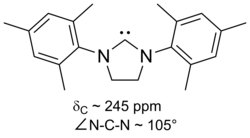
SIMes is a popular NHC ligand with a more flexible backbone compared to IMes

References
- ^ a b Steven P. Nolan (2006). N-Heterocyclic Carbenes in Synthesis. Wiley-VCH. ISBN 978-3-527-60940-6.
- ^ Arduengo, Anthony J.; Dias, H. V. Rasika; Harlow, Richard L.; Kline, Michael (1992). "Electronic stabilization of nucleophilic carbenes". Journal of the American Chemical Society. 114 (14): 5530–5534. Bibcode:1992JAChS.114.5530A. doi:10.1021/ja00040a007.
- ^ Ison, Elon A.; Ison, Ana (2012). "Synthesis of Well-Defined Copper N-Heterocyclic Carbene Complexes and Their Use as Catalysts for a "Click Reaction": A Multistep Experiment That Emphasizes the Role of Catalysis in Green Chemistry". Journal of Chemical Education. 89 (12): 1575–1577. Bibcode:2012JChEd..89.1575I. doi:10.1021/ed300243s.
- ^ Chen, Junting; Ritter, Tobias (2019). "Late-Stage Deoxyfluorination of Phenols with PhenoFluorMix". Org. Synth. 96: 16. doi:10.15227/orgsyn.096.0016.
- ^ Morgan Hans; Lionel Delaude (2010). "Microwave-Assisted Synthesis of 1,3-Dimesitylimidazolium Chloride". Org. Synth. 87: 77. doi:10.15227/orgsyn.087.0077.
- ^ Arnaud Gautier, Federico Cisnetti, Silvia Díez González, Clémentine Gibard (10 October 2012). "Synthesis of 1,3–bis(2,4,6–trimethylphenyl)–imidazolinium salts: SIMes·HCl, SIMes·HBr, SIMes·HBF4 and SIMes·HPF6". Protocol Exchange. doi:10.1038/protex.2012.048.
{{cite journal}}: CS1 maint: multiple names: authors list (link)
Further reading
- Bantreil, Xavier; Nolan, Steven P. (2011). "Synthesis of N-heterocyclic carbene ligands and derived ruthenium olefin metathesis catalysts". Nature Protocols. 6 (1): 69–77. doi:10.1038/nprot.2010.177. PMID 21212784. S2CID 30604456.

Content Disclaimer
Informasi ini disarikan dari Wikipedia dan disajikan kembali untuk tujuan edukasi. Konten tersedia di bawah lisensi CC BY-SA 3.0. Kami tidak bertanggung jawab atas ketidakakuratan data yang bersumber dari kontribusi publik tersebut.
- The information displayed on this website is sourced in part or in whole from Wikipedia and has been adapted for the purpose of restating it. We strive to provide accurate and relevant information, however:
- There is no guarantee of absolute accuracy. Wikipedia is an open, collaborative project that can be edited by anyone, so information is subject to change.
- It is not intended to constitute professional advice. The content displayed is for informational and educational purposes only. For important decisions (e.g., medical, legal, or financial), please consult a professional.
- Content copyright. Wikipedia is licensed under the Creative Commons Attribution-ShareAlike License (CC BY-SA). This means that content may be reused with appropriate attribution and shared under a similar license.
- Responsible use. Any risk arising from the use of information from this website is entirely the responsibility of the user.