Hyperiidea
| Hyperiidea | |
|---|---|

| |
| Hyperia (Hyperiidae) | |
Scientific classification 
| |
| Kingdom: | Animalia |
| Phylum: | Arthropoda |
| Clade: | Pancrustacea |
| Class: | Malacostraca |
| Order: | Amphipoda |
| Suborder: | Hyperiidea H. Milne-Edwards, 1830 |
| Families | |
|
See text | |
The Hyperiidea is one of the six suborders of amphipods, small aquatic crustaceans. Unlike some other suborders of Amphipoda, hyperiids are exclusively marine and do not occur in fresh water. Hyperiids are distinguished by their large eyes and planktonic habitat. Most species of hyperiids are parasites or predators of salps and jellyfish in the plankton, although Themisto gaudichaudii and a few relatives are free-swimming predators of copepods and other small planktonic animals.
Gallery
-
 Specimen of Streetsia challengeri (Oxycephalidae)
 -
 Specimen of Phronima sedentaria (Phronimidae)
 -
 Specimen of Themisto (Hyperiidae)
 -
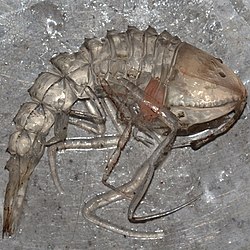 Specimen of Cystisoma (Cystisomatidae)
.jpeg)

.jpeg)

Taxonomy
According to World Amphipoda Database, 284 species of Hyperiidea are known in 2025.[1]
Some controversy exists as to the number of families in the Hyperiidea, being given as between 20 and 23 depending on whether groups like the Thaumatopsidae are considered distinct or not. The taxonomy of Hyperiidea currently accepted by the World Register of Marine Species is as follows:[2]
- Infraorder Physocephalata Bowman & Gruner, 1973
- Parvorder Physocephalatidira Bowman & Gruner, 1973
- Superfamily Phronimoidea Rafinesque, 1815
- Family Bougisidae Zeidler, 2004
- Family Cystisomatidae Willemöes-Suhm, 1875
- Family Dairellidae Bovallius, 1887
- Family Hyperiidae Dana, 1852
- Family Iulopididae Zeidler, 2004
- Family Lestrigonidae Zeidler, 2004
- Family Phronimidae Rafinesque, 1815
- Family Phrosinidae Dana, 1852
- Superfamily Platysceloidea Spence Bate, 1862
- Family Amphithyridae Zeidler, 2016
- Family Anapronoidae Bowman & Gruner, 1973
- Family Brachyscelidae Stephensen, 1923
- Family Eupronoidae Zeidler, 2016
- Family Lycaeidae Claus, 1879
- Family Lycaeopsidae Chevreux, 1913
- Family Oxycephalidae Dana, 1852
- Family Parascelidae Bovallius, 1887
- Family Platyscelidae Spence Bate, 1862
- Family Pronoidae Dana, 1852
- Family Thamneidae Zeidler, 2016
- Family Tryphanidae Boeck, 1871
- Superfamily Vibilioidea Dana, 1852
- Family Cyllopodidae Bovallius, 1887
- Family Paraphronimidae Bovallius, 1887
- Family Vibiliidae Dana, 1852
- Superfamily Phronimoidea Rafinesque, 1815
- Infraorder Physosomata Pirlot, 1929
- Parvorder Physosomatidira Pirlot, 1929
- Superfamily Lanceoloidea Bovallius, 1887
- Family Chuneolidae Woltereck, 1909
- Family Lanceolidae Bovallius, 1887
- Family Megalanceolidae Zeidler, 2009
- Family Metalanceolidae Zeidler, 2009
- Family Microphasmidae Stephensen & Pirlot, 1931
- Family Mimonecteolidae Zeidler, 2009
- Family Prolanceolidae Zeidler, 2009
- Superfamily Scinoidea Stebbing, 1888
- Family Archaeoscinidae K. H. Barnard, 1930
- Family Microscinidae Zeidler, 2012
- Family Mimonectidae Bovallius, 1885
- Family Mimoscinidae Zeidler, 2012
- Family Scinidae Stebbing, 1888
- Superfamily Lanceoloidea Bovallius, 1887
Distribution
Hyperiidea are known from many oceans of the world, including 69 species in the Southern Ocean.[3]
In the Streetsia challengeri, the left and right eyes fused to form a single cylindrical eye made of ~2500 ommatidia. It can see all around, but not ahead or behind.[4]
References
- ^ Statistics World Amphipoda Database. VLIZ (27.5.2025)
- ^ "Hyperiidea". WoRMS. World Register of Marine Species. Retrieved 2 July 2020.
- ^ C. De Broyer; K. Jazdzewski (1993). "Contribution to the marine biodiversity inventory: A checklist of the Amphipoda (Crustacea) of the Southern Ocean". Doc Trav Inst R Sci Nat Belg. 73. Archived from the original on 2011-07-06. Retrieved 2006-02-02.
- ^ Meyer-Rochow, V. B. (1978-01-17). "The eyes of mesopelagic crustaceans. II. Streetsia challengeri (amphipoda)". Cell and Tissue Research. 186 (2): 337–349. doi:10.1007/BF00225542. ISSN 0302-766X. PMID 203400.
Content Disclaimer
Informasi ini disarikan dari Wikipedia dan disajikan kembali untuk tujuan edukasi. Konten tersedia di bawah lisensi CC BY-SA 3.0. Kami tidak bertanggung jawab atas ketidakakuratan data yang bersumber dari kontribusi publik tersebut.
- The information displayed on this website is sourced in part or in whole from Wikipedia and has been adapted for the purpose of restating it. We strive to provide accurate and relevant information, however:
- There is no guarantee of absolute accuracy. Wikipedia is an open, collaborative project that can be edited by anyone, so information is subject to change.
- It is not intended to constitute professional advice. The content displayed is for informational and educational purposes only. For important decisions (e.g., medical, legal, or financial), please consult a professional.
- Content copyright. Wikipedia is licensed under the Creative Commons Attribution-ShareAlike License (CC BY-SA). This means that content may be reused with appropriate attribution and shared under a similar license.
- Responsible use. Any risk arising from the use of information from this website is entirely the responsibility of the user.