Hyper basis function network
In machine learning, a Hyper basis function network, or HyperBF network, is a generalization of radial basis function (RBF) networks concept, where the Mahalanobis-like distance is used instead of the Euclidean distance measure. Hyper basis function networks were first introduced by Poggio and Girosi in the 1990 paper “Networks for Approximation and Learning”.[1][2]
Network Architecture
The typical HyperBF network structure consists of a real input vector , a hidden layer of activation functions and a linear output layer. The output of the network is a scalar function of the input vector, , is given by


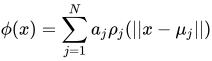
where is a number of neurons in the hidden layer, and are the center and weight of neuron . The activation function at the HyperBF network takes the following form


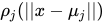

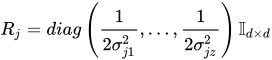
where is a positive definite matrix. Depending on the application, the following types of matrices are usually considered[3]


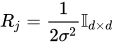
- , where . This case corresponds to the regular RBF network.
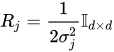
- , where . In this case, the basis functions are radially symmetric, but are scaled with different width.
- , where . Every neuron has an elliptic shape with a varying size.
- Positive definite matrix, but not diagonal.



Training
Training HyperBF networks involves estimation of weights , shape and centers of neurons and . Poggio and Girosi (1990) describe the training method with moving centers and adaptable neuron shapes. The outline of the method is provided below.
Consider the quadratic loss of the network . The following conditions must be satisfied at the optimum:
![{\displaystyle H[\phi ^{*}]=\sum _{i=1}^{N}(y_{i}-\phi ^{*}(x_{i}))^{2}}](https://wikimedia.org/api/rest_v1/media/math/render/svg/3bb8ce73fb7a2cf95034ba3f3b5a5bcd114e153f)
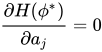
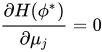
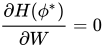
where . Then in the gradient descent method the values of that minimize can be found as a stable fixed point of the following dynamic system:


![{\displaystyle H[\phi ^{*}]}](https://wikimedia.org/api/rest_v1/media/math/render/svg/3a42b9a80e03a9a9256c2335defe237fe682cc28)
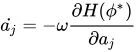
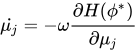
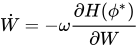
where determines the rate of convergence.

Overall, training HyperBF networks can be computationally challenging. Moreover, the high degree of freedom of HyperBF leads to overfitting and poor generalization. However, HyperBF networks have an important advantage that a small number of neurons is enough for learning complex functions.[2]
References
- ^ T. Poggio and F. Girosi (1990). "Networks for Approximation and Learning". Proc. IEEE Vol. 78, No. 9:1481-1497.
- ^ a b R.N. Mahdi, E.C. Rouchka (2011). "Reduced HyperBF Networks: Regularization by Explicit Complexity Reduction and Scaled Rprop-Based Training". IEEE Transactions of Neural Networks 2:673–686.
- ^ F. Schwenker, H.A. Kestler and G. Palm (2001). "Three Learning Phases for Radial-Basis-Function Network" Neural Netw. 14:439-458.
Content Disclaimer
Informasi ini disarikan dari Wikipedia dan disajikan kembali untuk tujuan edukasi. Konten tersedia di bawah lisensi CC BY-SA 3.0. Kami tidak bertanggung jawab atas ketidakakuratan data yang bersumber dari kontribusi publik tersebut.
- The information displayed on this website is sourced in part or in whole from Wikipedia and has been adapted for the purpose of restating it. We strive to provide accurate and relevant information, however:
- There is no guarantee of absolute accuracy. Wikipedia is an open, collaborative project that can be edited by anyone, so information is subject to change.
- It is not intended to constitute professional advice. The content displayed is for informational and educational purposes only. For important decisions (e.g., medical, legal, or financial), please consult a professional.
- Content copyright. Wikipedia is licensed under the Creative Commons Attribution-ShareAlike License (CC BY-SA). This means that content may be reused with appropriate attribution and shared under a similar license.
- Responsible use. Any risk arising from the use of information from this website is entirely the responsibility of the user.