Huff model
In spatial analysis, the Huff model is a widely used tool for predicting the probability of a consumer visiting a site, as a function of the distance of the site, its attractiveness, and the relative attractiveness of alternatives. It was formulated by David Huff in 1963.[1] It is used in marketing, economics, retail research and urban planning,[2] and is implemented in several commercially available GIS systems.
Its relative ease of use and applicability to a wide range of problems contribute to its enduring appeal.[3]
The formula is given as:
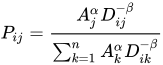
where :
- is a measure of the attractiveness of store j
- is the distance from the consumer's location, i, to store j.
- is an attractiveness parameter
- is a distance decay parameter
- is the total number of stores, including store j


References
- ^ Huff, David L. (1963). "A Probabilistic Analysis of Shopping Center Trade Areas". Land Economics. 39 (1): 81–90. doi:10.2307/3144521. ISSN 0023-7639. JSTOR 3144521.
- ^ "Huff, David | AAG". www.aag.org. Archived from the original on 2021-04-22. Retrieved 2021-04-20.
- ^ Dramowicz, Ela (2005-07-03). "Retail Trade Area Analysis Using the Huff Model". www.directionsmag.com. Retrieved 2021-04-20.
Content Disclaimer
Informasi ini disarikan dari Wikipedia dan disajikan kembali untuk tujuan edukasi. Konten tersedia di bawah lisensi CC BY-SA 3.0. Kami tidak bertanggung jawab atas ketidakakuratan data yang bersumber dari kontribusi publik tersebut.
- The information displayed on this website is sourced in part or in whole from Wikipedia and has been adapted for the purpose of restating it. We strive to provide accurate and relevant information, however:
- There is no guarantee of absolute accuracy. Wikipedia is an open, collaborative project that can be edited by anyone, so information is subject to change.
- It is not intended to constitute professional advice. The content displayed is for informational and educational purposes only. For important decisions (e.g., medical, legal, or financial), please consult a professional.
- Content copyright. Wikipedia is licensed under the Creative Commons Attribution-ShareAlike License (CC BY-SA). This means that content may be reused with appropriate attribution and shared under a similar license.
- Responsible use. Any risk arising from the use of information from this website is entirely the responsibility of the user.